Processed vs Ultra-Processed: NOVA Guide
Key Takeaways
While processed foods are modified for preservation, ultra-processed foods are industrial formulations designed to override satiety signals. This guide explains the NOVA scale in depth and offers science-backed strategies to identify and avoid UPFs.
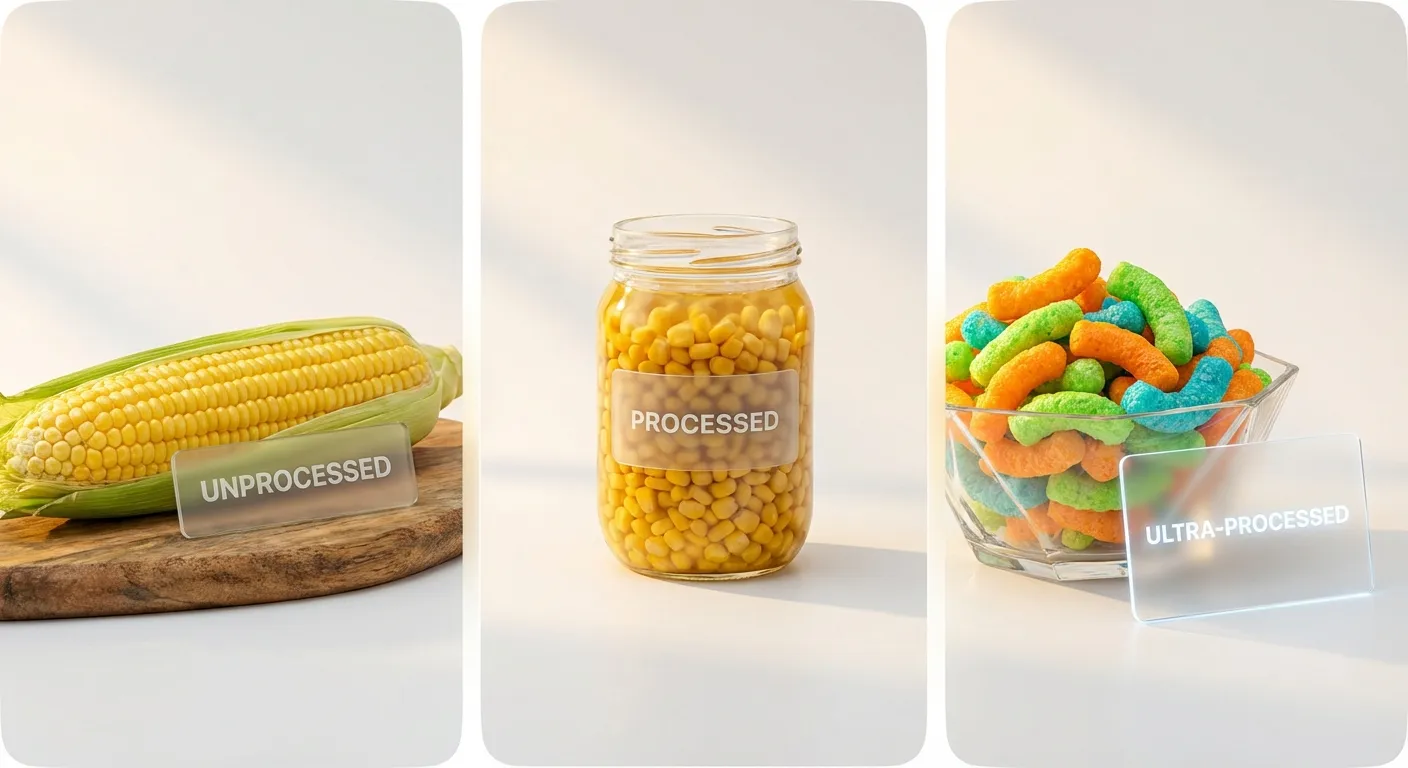
In the world of nutrition, "processed" has become a dirty word. We are constantly told to "eat clean" and "avoid processed foods." But this advice is often too simplistic and, frankly, confusing.
Is a can of chickpeas "processed"? Yes. Is it bad for you? Absolutely not. Is a bag of "veggie chips" processed? Yes. Is it healthy? Likely not.
To navigate the modern grocery store, we need a more sophisticated tool than just "processed vs. natural." We need to understand the NOVA classification system, the global standard adopted by researchers to distinguish between foods that nourish us and industrial formulations that disrupt our biology.
The Core Distinction: Purpose of Processing
The key difference lies not just in that the food was processed, but why and how.
- Processed Foods (Group 3) are altered to preserve them or make them more enjoyable. The underlying food matrix remains intact.
- Ultra-Processed Foods (Group 4) are created to replace real food with industrial formulations. They are designed for hyper-palatability, long shelf life, and high profitability. The original food matrix is often destroyed.
Deep Dive: The 4 NOVA Groups
Understanding these groups is the first step to reclaiming your metabolic health.
Group 1: Unprocessed or Minimally Processed Foods
These are the foundation of a healthy diet. They are plants or animals that have been altered only to make them safe or edible (cleaning, freezing, drying, pasteurizing).
- Examples: Fresh or frozen fruits/vegetables, grains (rice, oats), legumes (beans, lentils), fresh meat, eggs, milk, plain yogurt.
- Nutritional Value: The food matrix is intact, meaning fiber and nutrients are preserved in their natural state, ensuring slow digestion and stable blood sugar.
Group 2: Processed Culinary Ingredients
You rarely eat these alone. They are extracted from Group 1 foods and used to season and cook.
- Examples: Olive oil, butter, sugar, salt, vinegar, honey, maple syrup.
- Role: When used in moderation to cook Group 1 foods, they create nutritious, balanced meals.
Group 3: Processed Foods (The "Preservation" Tier)
This is where the nuance is critical. These products are made by adding Group 2 ingredients to Group 1 foods. The list of ingredients is usually short (2-4 items) and recognizable.
- Examples:
- Canned Vegetables: Corn, peas, or beans in water and salt.
- Cured Meats: Ham or bacon (traditional curing).
- Cheese: Made from milk, salt, and enzymes.
- Fresh Bread: Flour, water, yeast, salt.
- Pickles: Cucumbers, vinegar, salt.
- Verdict: These can be part of a healthy diet. They offer convenience without the metabolic damage of industrial additives.
Group 4: Ultra-Processed Foods (The "Industrial" Tier)
These are formulations of ingredients, mostly of exclusive industrial use, that result from a series of industrial processes (fractioning, hydrogenation, hydrolysis). They often contain little to no whole food.
Common Industrial Additives:
- Flavor Enhancers: MSG, yeast extract, hydrolyzed vegetable protein.
- Colors: Red 40, Yellow 5, Titanium Dioxide.
- Texturizers: Soy lecithin, carrageenan, guar gum, xanthan gum.
- Sweeteners: High-fructose corn syrup, aspartame, sucralose, maltodextrin.
Verdict: These foods are linked to chronic inflammation, insulin resistance, and obesity.
The Science: Why UPFs Are Different
It's not just about "empty calories." Ultra-processed foods interact with your body differently than real food.
1. The "Matrix" Effect
In whole foods (Group 1), nutrients are trapped in a fibrous matrix. Your body has to work to digest them, which blunts the insulin spike. In UPFs, this matrix is destroyed. The nutrients are pre-digested by machines, leading to rapid absorption and blood sugar spikes.
2. Hyper-Palatability and the "Bliss Point"
Food engineers design UPFs to hit the "bliss point"—the perfect ratio of salt, sugar, and fat that overrides your brain's "stop eating" signals. A 2019 NIH study found that people ate 500 calories more per day on an ultra-processed diet compared to an unprocessed diet, simply because the food was faster to eat and less satiating.
3. Gut Microbiome Disruption
Emerging research suggests that certain emulsifiers (like carboxymethylcellulose and polysorbate-80) found in UPFs can erode the protective mucus layer of the gut, potentially leading to "leaky gut" and systemic inflammation.
The Evolution of Food: A Comparison
Let's trace three common foods through the processing spectrum to see how the nutritional profile changes.
| Food Item | Group 1 (Unprocessed) | Group 3 (Processed) | Group 4 (Ultra-Processed) |
|---|---|---|---|
| Corn | Corn on the Cob(Corn) | Canned Corn(Corn, Water, Salt) | Doritos / Corn Chips(Corn, Veg Oil, Maltodextrin, MSG, Red 40, Artificial Flavor) |
| Apple | Fresh Apple(Apple) | Apple Sauce(Apples, Sugar) | Apple Gummy Candy(Corn Syrup, Sugar, Gelatin, Artificial Apple Flavor, Red 40) |
| Wheat | Wheat Berries(Wheat) | Sourdough Bread(Flour, Water, Salt, Starter) | White Sandwich Bread(Flour, HFCS, Soybean Oil, DATEM, Calcium Propionate, Azodicarbonamide) |
| Meat | Chicken Breast(Chicken) | Rotisserie Chicken(Chicken, Salt, Spices) | Chicken Nuggets(Chicken, Water, Flour, Veg Oil, Starch, Dextrose, Leavening, Spices) |
Practical Guide: How to Identify UPFs
You don't need a lab coat to spot ultra-processed foods. Use these three tests:
1. The "Kitchen Test"
Look at the ingredient list. Do you have these ingredients in your kitchen? You likely have sugar, salt, and flour. Do you have high-fructose corn syrup? Do you have interesterified oils? Do you have Red 40? If not, it's likely UPF.
2. The "Cosmetic" Rule
Is there an ingredient added purely to make the food look or taste better, rather than to nourish or preserve? Colors, flavors, and thickeners are the hallmarks of ultra-processing.
3. The Marketing Trap
Ironically, the more health claims a package has ("High Protein!", "Low Fat!", "Added Vitamins!"), the more likely it is to be ultra-processed. Real food (like broccoli or steak) rarely needs a marketing budget.
Smart Swaps for Better Health
You don't have to be perfect. Start by swapping your most frequent UPF offenders for Group 1 or Group 3 alternatives.
- Instead of: Flavored Fruit Yogurt (UPF) -> Try: Plain Greek Yogurt + Fresh Fruit (Group 1/3).
- Instead of: Breakfast Cereal (UPF) -> Try: Steel-Cut Oats with Nuts (Group 1).
- Instead of: Store-bought Salad Dressing (UPF) -> Try: Olive Oil + Vinegar (Group 2).
- Instead of: Protein Bar (UPF) -> Try: Hard-boiled Eggs or a Handful of Almonds (Group 1).
Conclusion
The goal of the NOVA scale isn't to make you fear food, but to empower you. You can enjoy processed foods like cheese, fresh bread, and canned vegetables without guilt. The real victory for your metabolic health comes from minimizing the industrial formulations that masquerade as food.
Unsure about the products in your pantry? Take the guesswork out of grocery shopping. Download Food For You today to instantly scan barcodes and reveal the NOVA score of any product. Get your personal food quality analyzer here.
References
- Monteiro, C. A., et al. (2019). "Ultra-processed foods: what they are and how to identify them." Public Health Nutrition, 22(5), 936-941.
- Hall, K. D., et al. (2019). "Ultra-Processed Diets Cause Excess Calorie Intake and Weight Gain: An Inpatient Randomized Controlled Trial of Ad Libitum Food Intake." Cell Metabolism, 30(1), 67-77.
- Srour, B., et al. (2019). "Ultra-processed food intake and risk of cardiovascular disease: prospective cohort study (NutriNet-Santé)." BMJ, 365, l1451.
- Chassaing, B., et al. (2015). "Dietary emulsifiers impact the mouse gut microbiota promoting colitis and metabolic syndrome." Nature, 519, 92-96.
- Fardet, A. (2016). "Minimally processed foods are more satiating and less hyperglycemic than ultra-processed foods: a preliminary study with 98 ready-to-eat foods." Food & Function, 7(5), 2338-2346.
Frequently Asked Questions
Team Food For You
Reviewed by: Dr. Arthur Price
The Food For You team combines AI technology with nutrition science to help people make safer, healthier food choices.
Learn more about usMedical Disclaimer
The content provided in this blog is for informational purposes only and does not constitute medical advice. Always consult with a qualified healthcare professional for diagnosis and treatment of allergies.
Related Articles
Are Protein Bars Healthy? Top 10 Ranked
We analyzed the top 10 protein bar brands of 2026 using the NOVA scale. Find out which are real food and which are just candy in disguise.
Metabolic Health 101: Beyond Weight Loss
Stop obsessing over the scale. Discover why metabolic health is the true indicator of longevity and learn about the dangers of the 'skinny fat' phenotype.
Food For You Guide: AI Food Scanner App
Forget barcodes. Food For You uses advanced AI Vision to analyze food labels and prepared dishes. Discover the most advanced personalized nutrition app of 2026.
