The Fiber Gap: Fibermaxxing Without Fake Bars
Key Takeaways
Fiber is officially the new protein. PepsiCo's CEO said so on an earnings call, McDonald's CEO posted about it, and TikTok turned it into a hashtag. But most of the new 'high-fiber' products on shelves get there with chicory root inulin and soluble corn fiber, not real food. We unpack the gap, the loophole, and a 30-gram day you can actually eat.
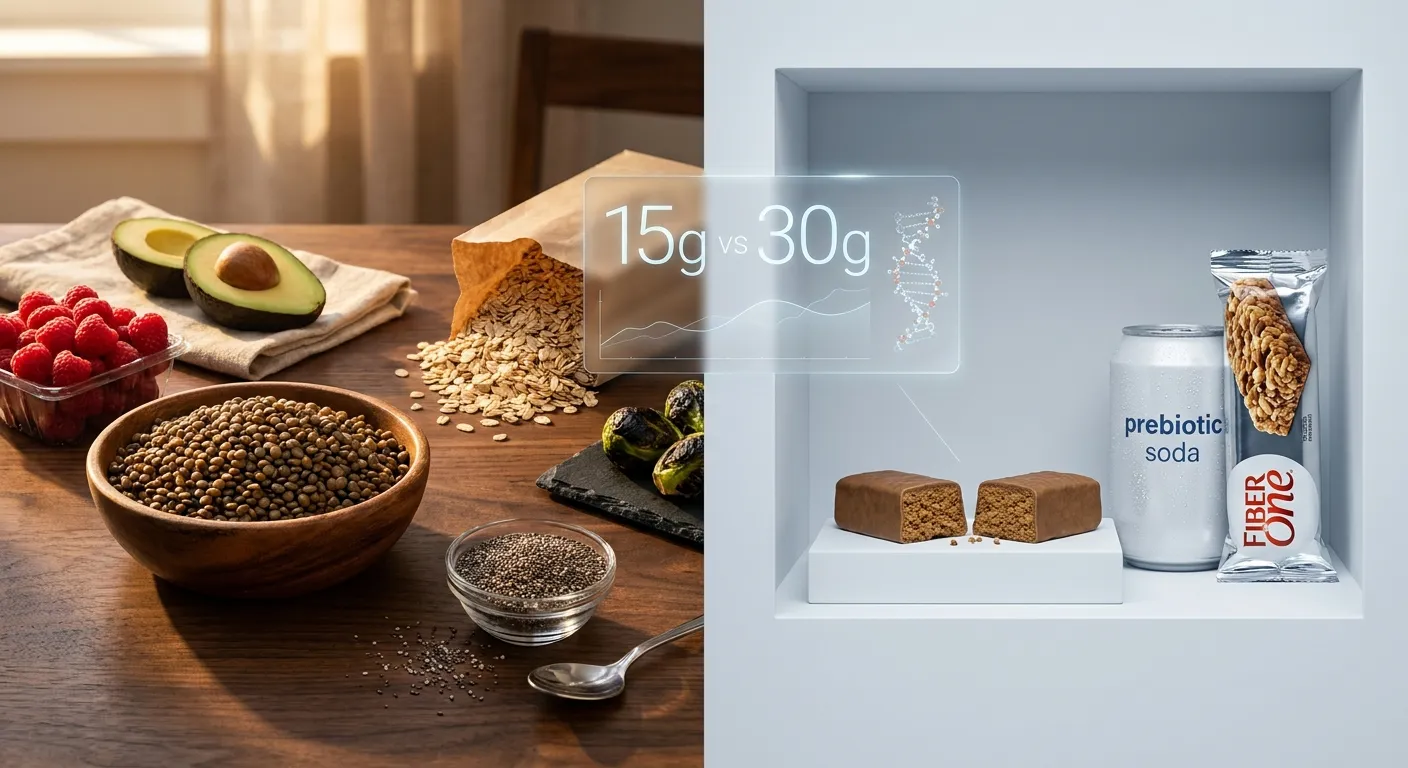
In October 2025, on a quarterly earnings call, PepsiCo CEO Ramon Laguarta told analysts that "fiber will be the next protein." A few weeks later, McDonald's CEO Chris Kempczinski posted on Instagram that fiber "is going to be big" in 2026. By February, PepsiCo had a prebiotic Pepsi on shelves nationwide and a "Smartfood FiberPop" launching alongside it. TikTok, of course, was already there: tens of millions of views under #fibermaxxing, mostly Gen Z stacking chia pudding and lentil soup on camera.
Two things can be true at once. Fiber genuinely is the most underrated macro in the American diet. And the food industry's response to that gap is going to be, predictably, a wave of products engineered to hit a fiber claim on the front of the box without doing what fiber actually does inside your body.
This piece is about both halves: the real gap, and the fake fix.
The Short Answer
Adult women should aim for 25g of fiber per day and adult men for 38g, per the Institute of Medicine. The average American eats roughly 15g. Closing that gap is one of the highest-leverage moves you can make for cardiovascular risk, colon health, blood sugar, and the gut hormones that govern hunger. But "fiber" on a label is not one ingredient. Fiber from lentils, oats, raspberries, and chia behaves differently from chicory root inulin sprayed into a protein bar. If you're going to fibermaxx in 2026, do it with food first.
The 30-Second TL;DR
- Target: 25g/day (women), 38g/day (men). Datassential's 2026 trends report says 54% of consumers are interested in high-fiber foods; 60% of Gen Z are.
- Reality: ~15g/day average. Roughly 95% of Americans miss the target.
- Why it matters: Each extra 7g/day is associated with about a 9% lower cardiovascular risk; each extra 10g/day with about a 10% lower colorectal cancer risk.
- The catch: Many "high-fiber" packaged products use isolated fiber (inulin, soluble corn fiber, polydextrose) that may not deliver the same benefits as fiber locked inside whole foods.
- The rule: Ramp slowly, about 5g per week, drink more water, and don't out-source the whole job to a bar.
The Fiber Gap: Why "Healthy Eating" Doesn't Get You There
Most people who hear the 25-38g target assume they're already there. They're usually not. Run the numbers on a self-described "healthy" Tuesday:
- Greek yogurt with a handful of granola for breakfast: ~3g
- A turkey sandwich on whole wheat with lettuce and tomato: ~5g
- An apple at 3pm: ~4g
- Salmon with white rice and broccoli for dinner: ~4g
- A square of dark chocolate: ~1g
That's 17g. Whole-grain bread, an apple, broccoli, and a chocolate finish, and you're still 8 to 21 grams short depending on whether you're a woman or a man. Nothing is wrong with that day. It's just not a fiber day. The difference between 17g and 30g isn't willpower; it's the structure of the meals.
This is where fibermaxxing as a behavior change actually makes sense. The trend isn't "eat one extra apple." It's "treat fiber the way you've spent the last three years treating protein": pick a target, count it, and design at least one fiber-anchored item into every meal.
Real Fiber vs Added Fiber: The Inulin Loophole
This is where the 2026 product wave splits, and where most shoppers will get fooled.
The FDA's current definition of dietary fiber, finalized in 2016 and expanded in 2018, allows manufacturers to count two things on the Nutrition Facts panel: fiber that is intrinsic and intact in plants (the broccoli kind), and isolated or synthetic non-digestible carbohydrates that the FDA has accepted as having a beneficial physiological effect. The accepted list includes inulin (chicory root fiber), polydextrose, soluble corn fiber, soluble fiber dextrin, mixed plant cell wall fiber, arabinoxylan, alginate, and a few others.
Legally, all of these go on the label as "Fiber 8g" or "Fiber 12g." Functionally, they are not the same thing.
Whole-food fiber from a bowl of lentils arrives wrapped in a food matrix: protein, magnesium, folate, polyphenols, resistant starch, slow-release carbohydrate. It slows gastric emptying, blunts the glucose response, feeds a wide spectrum of gut bacteria, and produces short-chain fatty acids that signal satiety hormones. Isolated inulin powder added to a soda or a bar can do some of that. It's a real prebiotic; it does feed bifidobacteria. But it shows up alone, in a vehicle that's often otherwise ultra-processed, and the fermentation it produces in a sensitive gut can be aggressive enough to send people running for the bathroom.
The Quest bar is the canonical example. A Quest bar lists 12-14g of fiber, almost all from soluble corn fiber. Fiber One bars do something similar with chicory root. The new Pepsi Prebiotic Cola gets its 3g of fiber from inulin. Olipop gets 9g the same way. Even SunChips Fiber and Smartfood FiberPop, the PepsiCo launches built explicitly for the fibermaxxing wave, lean on a mix of added fibers and a few real ones (whole grains, black beans).
The honest framing isn't "added fiber is bad." It's that isolated fiber pulled out of one plant and shaken into a different food does some of what whole-food fiber does, but not all of it. Sonya Angelone, a spokesperson for the Academy of Nutrition and Dietetics, put it cleanly: isolated fibers "lack the natural components that may contribute synergistically to the benefit of the fiber itself." If you're using a Pepsi Prebiotic to replace a regular Pepsi, that's a small win. If you're using an inulin-fortified bar to replace half a cup of lentils, that's a downgrade with a "+12g fiber" sticker on it.
Fibermaxxing Without Wrecking Your Gut
The most common failure mode of fibermaxxing is going from 15g to 40g in a single Tuesday. Your microbiome can adapt — but not that fast. Bacteria that ferment fiber need time to scale up, and in the meantime, the byproducts are gas, bloating, and cramping. People who are already managing IBS, IBD, or FODMAP sensitivity have a sharper version of this problem; for them, inulin in particular can be a known trigger.
Three rules make the ramp survivable:
Add roughly 5g per week, not per day. Pick one anchor food, eat it consistently for a week, then add the next. Oatmeal first. Then beans at one meal. Then chia. Then a fiber-forward dinner.
Drink more water. Soluble fiber works by absorbing water and forming a gel that slows digestion and softens stool. Without enough water, the same fiber that should help you can constipate you. There's no perfect number, but a useful heuristic is an extra glass with each fiber-heavy meal.
Lean on low-FODMAP soluble fiber if your gut is sensitive. Oats, chia, kiwi, oranges, berries, carrots, and quinoa generally tolerate well. Onions, garlic, beans, wheat, and inulin-fortified anything are the usual triggers. If you have diagnosed IBS or IBD, talk to your doctor or a registered dietitian before pushing past 25g.
The 30-Gram Day: A Whole-Food Template
Here's a day that hits the women's target with room to spare, and lands a man at about 80% of his goal, using nothing fortified.
| Meal | Food | Fiber |
|---|---|---|
| Breakfast | 1/2 cup rolled oats, 1 tbsp chia, 1 cup raspberries | ~14g |
| Lunch | 1 cup cooked lentil soup, 2 slices rye | ~12g |
| Snack | 1 medium pear with skin, 20 almonds | ~7g |
| Dinner | Salmon, 1 cup roasted brussels sprouts, 1/2 cup quinoa | ~9g |
| Total | ~42g |
Notice what's missing: no bars, no fortified cereal, no prebiotic soda. Lentils alone deliver 15g per cooked cup. A cup of raspberries is 8g. Two tablespoons of chia is roughly 9g. The fiber is already in the produce aisle and the dry-goods shelf; the food industry's job in 2026 is to convince you it's not.
High-Fiber Bars and Cereals: What Survives a Label Scan
If you're going to use packaged products to fill a gap, these are the questions to ask the label, in order.
1. Where is the fiber listed in the ingredients? If "chicory root fiber," "inulin," "soluble corn fiber," or "polydextrose" appears in the first five ingredients, the fiber count on the front of the box is mostly engineered, not inherited from a plant.
2. Is there a recognizable whole-food fiber source? Oats, beans, lentils, chickpeas, whole flaxseed, chia, raspberries, dates, nuts. If yes, the bar or cereal is doing some real work.
3. Are the sweeteners sugar alcohols? Maltitol, sorbitol, and xylitol stack their own bloating risk on top of any added-fiber bloating risk. Erythritol is gentler but isn't free.
4. Is the fiber-to-sugar ratio sane? A "high-fiber" granola bar with 7g of fiber and 14g of added sugar isn't a fiber product; it's a candy bar with a halo.
By those rules, RXBAR (dates, nuts, egg whites — fiber from real fruit and nuts) clears the bar. So does plain rolled oatmeal, Ezekiel bread, and most of the Bob's Red Mill catalog. Quest bars and Fiber One bars technically deliver fiber but mostly the engineered kind. Raisin Bran, the cereal that's about to run a William Shatner Super Bowl ad about pooping, is somewhere in the middle: real bran fiber, real raisins, but a lot of added sugar.
The Pepsi Prebiotic Cola is interesting precisely because the comparison isn't "bar vs lentils." It's "this vs a regular Pepsi." Three grams of inulin and 5g of sugar is genuinely better than 0g of fiber and 41g of sugar. It's still not a fiber strategy.
The Hidden Cost of Skipping Fiber
The reason any of this matters is that the gap isn't aesthetic. The gap costs years.
A 2025 systematic review and meta-analysis confirmed the long-standing finding that each additional 7g of fiber per day is associated with roughly a 9% reduction in cardiovascular disease risk. A separate 2023 update covering 3.5 million subjects found that higher total fiber intake was associated with a 23% reduction in all-cause mortality, 26% in cardiovascular mortality, and 22% in cancer mortality, with insoluble fiber slightly outperforming soluble for total mortality.
The colon-cancer math is similarly stubborn: in the BMJ dose-response meta-analysis (Aune et al.), each 10g/day of total fiber lowered colorectal cancer risk by about 10%, with cereal fiber showing the strongest signal. The mechanism is plausible: faster transit time, dilution of fecal carcinogens, and bacterial fermentation into butyrate, which appears to suppress colonic tumor development in animal models.
There's also the GLP-1 connection, which is what put fiber back in the Wall Street pitch decks. Pharmaceutical GLP-1 agonists (Ozempic, Wegovy) work by mimicking a satiety hormone your body already makes. Fiber, fermented in the colon into short-chain fatty acids, activates the same pathway: SCFAs bind FFAR2/FFAR3 receptors on intestinal L cells, which release GLP-1 and PYY, which slow gastric emptying and signal fullness to the brain. A 2013 trial of inulin-propionate ester (10g/day) measurably increased GLP-1 and PYY and reduced food intake. This is not a substitute for the drugs, but it's not nothing — and it explains why the food industry sniffed out fiber the same year semaglutide became a household word. If you're trying to feel full without an injection, fiber is the closest analog you can buy at a grocery store.
For broader context on why energy regulation matters more than the number on the scale, see our metabolic health primer. For the gut-brain side of the same conversation, see our gut-brain explainer.
Track what you actually eat. Most people who think they hit 25g of fiber are off by 30%. Use the Food For You diary to log meals and watch fiber climb in real time, no spreadsheets, no guessing.
Comparison: Whole-Food Fiber vs Added Fiber
| Source | Typical Serving | Fiber | What's Around It |
|---|---|---|---|
| Cooked lentils | 1 cup | ~15g | Protein, folate, iron, polyphenols |
| Chia seeds | 2 tbsp | ~9g | Omega-3, calcium, magnesium |
| Raspberries | 1 cup | ~8g | Vitamin C, ellagic acid, polyphenols |
| Black beans | 3/4 cup | ~11g | Protein, resistant starch, anthocyanins |
| Rolled oats | 1/2 cup dry | ~4g | Beta-glucan, manganese |
| Quest Bar | 1 bar | ~12g | Soluble corn fiber, milk protein isolate, sucralose |
| Fiber One bar | 1 bar | ~7g | Chicory root, sugar, palm oil |
| Pepsi Prebiotic | 1 can | ~3g | Inulin, 5g cane sugar, caffeine |
| Olipop | 1 can | ~9g | Cassava, chicory, agave inulin |
The whole-food rows give you fiber plus a long supporting cast. The packaged rows give you a fiber number plus, usually, an ingredient list you wouldn't recognize as food a generation ago.
Conclusion
Fibermaxxing is going to win 2026 the same way protein won 2024. There will be Super Bowl ads. There will be a "fiber" sticker on every cereal box by Q3. And there will be a stack of products on the shelf that hit a fiber claim through chicory root powder while the actual lentil aisle stays where it always was.
The food industry isn't wrong that Americans need more fiber. They're just betting you'd rather buy it than chew it. If you flip the bet — eat the beans, eat the oats, eat the chia, treat fortified products as a top-up rather than a backbone — you'll close the gap with a stronger version of what fiber is supposed to do.
Not sure what your day actually adds up to? Use the Food For You app to scan labels and log meals. We separate intrinsic fiber from added fiber, calculate the NOVA classification and a Health Score, and show your daily total against your target, so you can see when you're really hitting 30g and when a "high-fiber" wrapper is doing the talking for you.
Create your free account today and start eating smarter.
References
- Houston Methodist (Jan 2026). Fibermaxxing: Should You Try the High-Fiber Diet Trend? Link
- Tufts Now (Oct 2025). Maxing Out Your Fiber Intake Can Have Broad Health Benefits. Link
- Threapleton, D. E., et al. (2013). Dietary fibre intake and risk of cardiovascular disease: systematic review and meta-analysis. BMJ. Link
- Aune, D., et al. (2011). Dietary fibre, whole grains, and risk of colorectal cancer: systematic review and dose-response meta-analysis of prospective studies. BMJ. Link
- Tolhurst, G., et al. (2012). Short-chain fatty acids stimulate glucagon-like peptide-1 secretion via the G-protein-coupled receptor FFAR2. Diabetes. Link
- CNBC / Datassential (Dec 2025). Food brands chase fibermaxxing trend with new high-fiber products. Link
Frequently Asked Questions
Team Food For You
Reviewed by: Dr. Arthur Price
The Food For You team combines AI technology with nutrition science to help people make safer, healthier food choices.
Learn more about usMedical Disclaimer
The content provided in this blog is for informational purposes only and does not constitute medical advice. Always consult with a qualified healthcare professional for diagnosis and treatment of allergies.
Related Articles
How Much Protein Do You Actually Need? 2026 Guide
The 0.8 g/kg RDA is from 1968. New evidence puts most adults at 1.2-1.6 g/kg, older adults higher. A by-age cheat-sheet, no powder required.
Food & Mood: Gut-Brain Connection Guide
Discover the science behind the gut-brain axis. Learn how ultra-processed foods affect mental health and which foods naturally boost serotonin.
Ultra-Processed Food: The 4 Legal Definitions of 2026
No official US definition of ultra-processed food exists yet, just four competing ones. What NOVA, the FDA white paper, California and Arizona each say in 2026.
