Is It Ultra-Processed? 30 Foods Decoded
Key Takeaways
Most NOVA primers stop at definitions. This one walks 30 common foods through the classification, explains the specific ingredient or process that decides each verdict, and ends with the foods that are technically ultra-processed but nutritionally fine. The point: skip the fear, learn the heuristic, and you can decide for yourself.
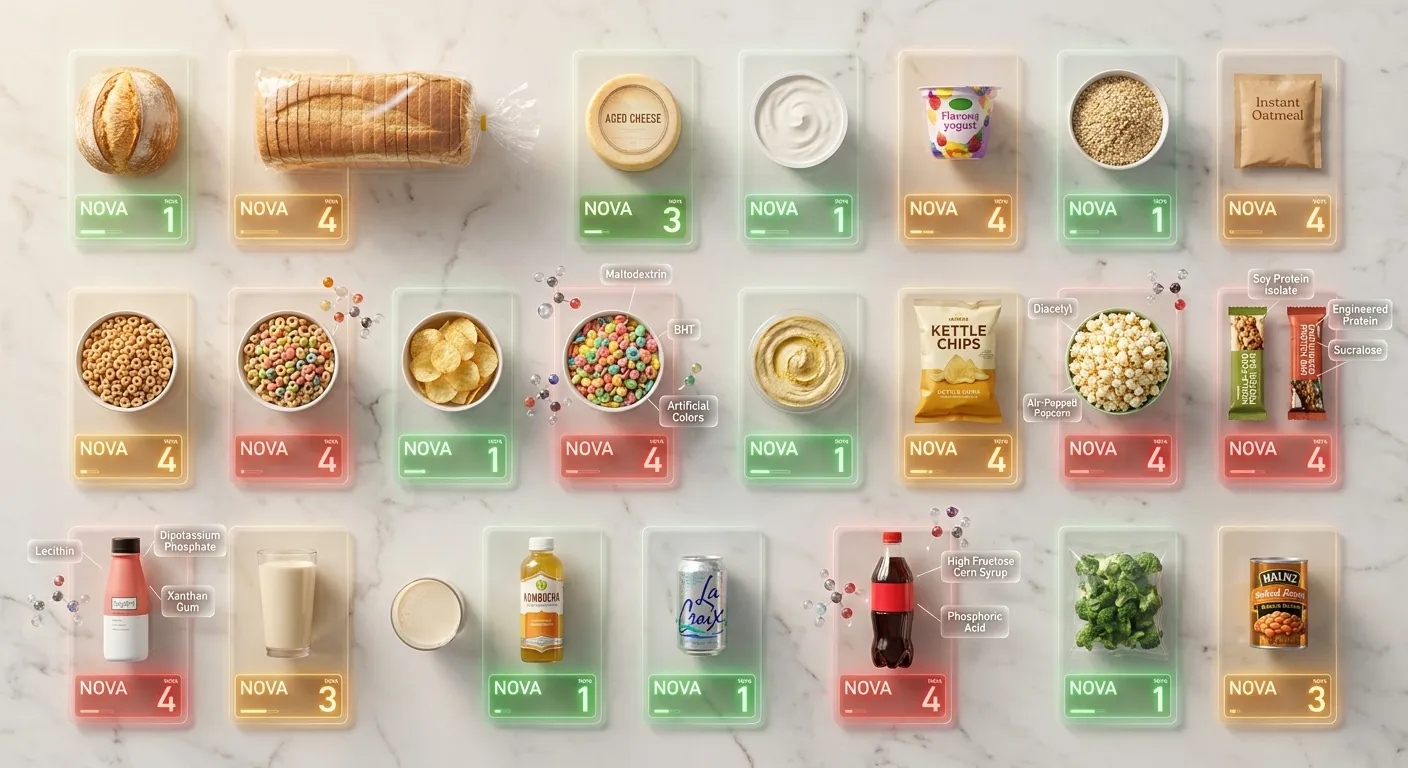
I was at Trader Joe's last week holding a granola bar called "Sea Salt and Turbinado Sugar Almond." The front of the package read like a farmers' market chalkboard. The back listed brown rice syrup, soluble tapioca fiber, palm oil, soy lecithin, and "natural flavor." The product had a halo. The ingredient panel told a different story.
This is the situation NOVA was built for. The classification system, developed in 2009 by Carlos Monteiro's team in São Paulo, ignores marketing and asks one question: how was this food made? The answer puts it into one of four groups, with NOVA 4 — ultra-processed — being the one most strongly associated with weight gain, cardiovascular risk, and metabolic disease in modern epidemiology.
The problem is that no top-ranking guide gives you a food-by-food answer for the things actually in your cart. Most primers explain the four groups and then leave you to argue with yourself in aisle 7. This piece is the opposite. Thirty foods, one verdict each, with the specific ingredient or process that decides it.
A note up front: some ultra-processed foods are nutritionally fine. The closing section names four. Calling NOVA a moral framework is a misuse of it. Calling it a useful lens for reading labels is exactly what its authors intended.
The Short Answer
Most packaged food in a US supermarket is NOVA 4. The classification rule is mechanical: if the ingredient list contains a substance you would not stock in a home kitchen — protein isolate, modified starch, soluble corn fiber, "natural flavor", dipotassium phosphate, sucralose, high-fructose corn syrup — the product is ultra-processed. The follow-up question, which NOVA does not answer, is whether that matters for the specific food. For sugary drinks and processed meats, the answer is yes. For whole-grain bread and plain yogurt, the answer is mostly no.
NOVA in 30 Seconds
The four groups, in plain English:
| Group | What it means | Real examples |
|---|---|---|
| NOVA 1 | Whole or barely altered foods. No additives. | Apples, oats, eggs, plain milk, frozen broccoli, dried beans |
| NOVA 2 | Cooking ingredients pressed or refined from NOVA 1. | Olive oil, butter, sugar, salt, honey, vinegar |
| NOVA 3 | NOVA 1 foods + NOVA 2 ingredients. Recognizable. | Sourdough bread, canned chickpeas, feta cheese, smoked salmon |
| NOVA 4 | Industrial formulations with substances you do not have at home. | Soda, instant noodles, most cereals, nuggets, plant milks with stabilizers, packaged whole-grain bread with dough conditioners |
The 80/20 rule is what most evidence supports. Eighty percent of calories from NOVA 1, 2, and 3. Twenty percent for whatever, including NOVA 4. A 2019 NIH metabolic-ward study by Kevin Hall found people ate 500 calories more per day on a NOVA 4 diet than on a whole-food diet, even when the meals were matched for sugar, fat, sodium, and fiber. That is the case against eating mostly NOVA 4. It is not a case against ever touching it.
How to Tell, Without a Lab: The 5-Question Test
Before the food-by-food list, here is the heuristic that gets you 90% of the way there. Ask all five questions of the ingredient list, not the front of the package.
- Does it contain an ingredient you would not stock at home? Protein isolate, maltodextrin, modified food starch, mono- and diglycerides, dipotassium phosphate, sucralose, "natural flavor", soluble corn fiber, gum acacia. If yes, it is NOVA 4.
- Is it engineered for shelf life? Calcium propionate, sodium benzoate, potassium sorbate, BHT, EDTA. Their job is to stop the product from going bad on a shelf. Their presence is a NOVA 4 tell.
- Was the food matrix destroyed and rebuilt? Extrusion (most cereals, puffs), reconstitution (chicken nuggets, plant patties), hydrogenation (margarine), and high-pressure homogenization with emulsifiers (most plant milks, coffee creamers).
- Was a sweetener added that is not sugar, honey, or fruit? High-fructose corn syrup, agave syrup, brown rice syrup, sucralose, aspartame, erythritol, monk fruit extract. All of these signal industrial formulation.
- Is the front of the package working hard? "High protein", "low fat", "added fiber", "no artificial colors". Real food does not need a marketing campaign. The more health claims, the higher the chance of NOVA 4.
If you would rather not run this in your head every time, the Food For You app will run it for you in two seconds — scan the barcode, get the NOVA group and a Health Score that grades the food on actual nutrition, not just classification.
The 30 Foods
Bread
1. Sourdough (artisan, from a bakery)
NOVA 3. Flour, water, salt, starter culture. That is the whole list. The slow fermentation breaks down phytates and lowers the glycemic response, but classification-wise it is the salt that pushes it into Group 3 — by NOVA logic, adding any culinary ingredient (here, salt) to a Group 1 food makes it Group 3. This is the bread you do not need to think about.
2. Sliced supermarket bread (Wonder, Sara Lee classic, mass-market store brand)
NOVA 4. The ingredient list typically runs 20+ items: enriched flour, high-fructose corn syrup, soybean oil, DATEM, sodium stearoyl lactylate, calcium propionate, monoglycerides, azodicarbonamide (in some markets, banned in the EU). Those last six are dough conditioners and shelf-life extenders. None of them are in your kitchen. This is NOVA 4 by every reading of the system.
3. Dave's Killer Bread (21 Whole Grains and Seeds)
NOVA 4 by strict classification, NOVA 3-equivalent by intent. Dave's avoids the dough conditioners and chemical preservatives that define standard supermarket bread, which is why some dietitians treat it as a Group 3 outlier. But it includes organic wheat gluten, organic cultured wheat flour, and added oat fiber — ingredients that, by the letter of NOVA, push it into Group 4. The honest answer in 2026 is that this is one of the cleanest commercial breads on the shelf, but it is not a sourdough loaf. Eat it without anxiety.
Yogurt and Dairy
4. Plain whole-milk Greek yogurt
NOVA 1. Two ingredients: milk and live cultures. Strained for thickness, no stabilizers needed. This is the closest thing to "yogurt the way it has been made for 5,000 years" that you can buy in a supermarket.
5. Plain regular yogurt (Stonyfield, Brown Cow, etc.)
NOVA 1, sometimes NOVA 4. The brands that list only milk and cultures are NOVA 1. The brands that add pectin, gelatin, modified corn starch, or "natural flavor" to thicken without straining slip into Group 4 by classification — even though nutritionally they are nearly identical to plain Greek. This is one of the cases where NOVA's strict ingredient rule overstates the harm.
6. Flavored fruit yogurt (Yoplait Strawberry, Chobani Flips)
NOVA 4. The flavored versions add sugar (often 12-18g per cup, more than a glazed donut), modified corn starch, fruit puree concentrate, "natural flavor", and pectin. Some brands also include red coloring (carmine, Red 40) and gelatin. The protein and calcium are real; the sugar load and additive list put it firmly in NOVA 4.
7. Skyr (Siggi's, Icelandic Provisions)
NOVA 1 (plain) or NOVA 4 (flavored). Plain skyr is milk and cultures, like plain Greek. Flavored varieties add cane sugar, fruit, and pectin or locust bean gum, which moves them to Group 4. Skyr's selling point is its protein density (15-20g per cup) — for that, the plain version is the clear winner.
8. Oat milk (basic, like Oatly Original)
NOVA 4. The giveaway is dipotassium phosphate — an acidity regulator that stops the milk from curdling in coffee, and one that no home cook keeps on the counter. The full list also runs through rapeseed oil, calcium carbonate, gellan gum, and a synthetic vitamin pack. Oats are healthy; this formulation is industrial. (See entry 22 for barista versions.)
Cereals and Grains
9. Steel-cut oats (Bob's Red Mill, McCann's)
NOVA 1. Whole oat groats cut with a steel blade. One ingredient. The slow cook time is a feature, not a flaw — the intact grain structure is what blunts the glycemic response.
10. Instant oatmeal packets (Quaker Maple & Brown Sugar)
NOVA 4. Pre-cooked, rolled thinner than rolled oats, then dried — that is acceptable processing. What pushes it to Group 4 is what is added: brown sugar, sugar, natural and artificial flavor, salt, calcium carbonate, sometimes maltodextrin. Plain instant oats with no flavoring are still Group 1; the flavored packets are not.
11. Cheerios (Original)
NOVA 4. Whole-grain oats, corn starch, sugar, salt, tripotassium phosphate, vitamin E for freshness. The first ingredient is real, but the second is the binder that holds the extruded "O" shape together, and extrusion at high heat and pressure is the textbook NOVA 4 process. Cheerios are still one of the lower-sugar cereals on the shelf. Classification-wise they are Group 4.
12. Lucky Charms
NOVA 4, decisively. Whole-grain oats, sugar, modified corn starch, corn syrup, dextrose, gelatin, Yellow 5, Yellow 6, Red 40, Blue 1, natural and artificial flavor. The marshmallow shapes are extruded sugar, gelatin, and color. This is not a borderline call.
Snacks
13. Hummus (Sabra, Cedar's, supermarket store brand)
NOVA 4. The base of chickpeas, tahini, lemon, garlic, and olive oil is Group 3. What pushes most retail hummus into Group 4 is the preservative load — potassium sorbate, citric acid, sometimes natural flavor and an emulsifier. Brands using high-pressure processing instead of chemical preservatives can stay in Group 3, but they are the exception. Make it at home and it is Group 1.
14. Crackers (Triscuits, Wheat Thins, Cheez-Its)
NOVA 4 for almost all of them. Triscuits are an outlier — three ingredients (whole wheat, oil, salt) put them at Group 3. Wheat Thins, Cheez-Its, Ritz, and most flavored crackers add HFCS, soy lecithin, monoglycerides, "natural flavor", autolyzed yeast extract, and color — all NOVA 4 markers.
15. Kettle chips (Kettle Brand Sea Salt)
NOVA 3 if the bag has three ingredients, NOVA 4 if it does not. Plain salted kettle chips with potatoes, oil, and salt are technically Group 3 — frying is allowed at this tier. Flavored varieties (sour cream and onion, salt and vinegar, jalapeño) add maltodextrin, dehydrated sour cream, "natural flavor", and yeast extract, all of which move them to Group 4. Read the bag.
16. Microwave popcorn (Orville Redenbacher Movie Theater Butter)
NOVA 4. The kernel is fine; the engineered butter coating and the bag chemistry are not. Beyond popcorn, palm oil, and salt, the bag contributes butter "natural flavor", annatto coloring, TBHQ as preservative, and historically PFAS in the lining (mostly phased out by 2026, but the formulation is still industrial).
17. Air-popped popcorn (kernels in a hot-air popper or paper bag in the microwave)
NOVA 1. Just corn. Add salt and oil at the table and you are still in Group 2 territory. The cheapest and most processed-looking gadget in your kitchen produces one of the least processed snacks you can eat.
Protein Bars, Powders, and Meal Replacements
18. RXBAR (Chocolate Sea Salt)
NOVA 3. Pressed trail mix is the honest description: dates, egg whites, almonds, cashews, cocoa, sea salt. The lone Group 4 marker is "natural chocolate flavor", which some classifiers treat as a borderline call rather than a hard demotion. One of the cleanest commercial bars on the market.
19. Quest bar (Chocolate Chip Cookie Dough)
NOVA 4. Three textbook NOVA 4 markers do the work here: milk protein isolate, soluble corn fiber, sucralose. The rest of the list (almonds, water, erythritol, palm oil, unsweetened chocolate, sea salt) is along for the ride. Quest is fine as occasional protein. It is not health food.
20. Whey protein isolate powder (unflavored, single-ingredient)
NOVA 4 by classification, harmless in practice. NOVA explicitly names whey protein, casein, and soy protein isolate as Group 4 marker ingredients — they are produced by industrial filtration that does not happen in any kitchen. Unflavored, single-ingredient whey is one of the cleaner protein powders you can buy, but the classification still applies. Flavored powders with sucralose, gums, and "natural flavors" are deeper into Group 4.
21. Soylent (Original)
NOVA 4. This is the platonic ideal of an ultra-processed food: engineered, nutritionally complete, designed to displace cooking. The build is soy protein isolate, sunflower and canola oils, isomaltulose, maltodextrin, soluble corn fiber, and a synthetic vitamin and mineral matrix. Whether it is healthy is a separate question (the macros are reasonable; the long-term data is thin), but the classification is unambiguous.
Drinks
22. Oat milk, barista version (Oatly Barista, Califia Barista Blend)
NOVA 4. All the ingredients of basic oat milk plus higher fat content, additional emulsifiers (sometimes sunflower lecithin, gellan gum), and acidity regulators tuned for steaming. The barista version is more processed than the basic version, which was already Group 4.
23. Kombucha (raw, traditional — GT's Synergy Original, Health-Ade)
NOVA 1 or 3. Tea, sugar (consumed by the SCOBY during fermentation), and live culture. Plain and traditionally fermented kombucha sits at Group 1 by spirit, Group 3 if you count the residual sugar. The flavored bottled versions that add fruit juice concentrate, "natural flavor", or stevia leaf extract move into Group 4.
24. Sparkling water with "natural flavors" (LaCroix, Bubly, Spindrift)
Splits cleanly: Spindrift is NOVA 1, LaCroix and Bubly are NOVA 4. Spindrift uses real squeezed fruit and nothing else — minimally processed. LaCroix and Bubly use carbonated water plus "natural flavor" essences extracted via industrial solvent processes. The latter are technically Group 4, even though they have zero calories and no sweeteners. This is a case where the NOVA verdict and the nutritional verdict diverge.
25. Protein shakes, ready-to-drink (Premier Protein, Fairlife Core Power)
NOVA 4. The protein is real (30g+) and the carbs are low, but the way that protein gets to drinkable shelf-stable form runs through milk protein isolate, carrageenan, cellulose gel and gum, soy lecithin, sucralose, and "natural and artificial flavor". Useful for convenience; not equivalent to a glass of milk and an egg.
26. Soda (Coke, Pepsi, off-brand cola)
NOVA 4. The defining example. Six ingredients, none of which a home cook would have: carbonated water, HFCS, caramel color, phosphoric acid, "natural flavors", caffeine. Sugary soft drinks carry the strongest health-harm signal of any NOVA 4 category in current 2026 evidence, and Johns Hopkins specifically calls them out as the first thing to cut.
The Ultra-Processed but Actually Fine List
This is the section most NOVA articles skip. Some Group 4 foods are nutritionally good. The classification flags how they were made, not whether they are healthy. Here are four to stop worrying about.
27. Whole-grain bread with one or two stabilizers (Ezekiel sprouted, Silver Hills, similar)
NOVA 4 by letter, NOVA 3 by spirit. A 100% whole-grain or sprouted-grain bread with one stabilizer (lecithin, citric acid) is a fundamentally different product from a bleached white loaf with HFCS and dough conditioners. Stanford's Christopher Gardner has been the most vocal on this point: the NOVA 4 label here adds noise, not signal. Eat the whole-grain bread.
28. Canned baked beans in tomato sauce (Bush's, Heinz)
NOVA 4 by letter, dinner by intent. The classifier-tripping ingredients are modified food starch and "natural flavor", sitting next to beans, tomato puree, sugar, salt, and garlic powder. Nutritionally: 8g of protein, 6g of fiber, and a serving of legumes for 110 calories. The sugar load is real (8-10g per serving), but if the alternative is no beans, this is a clear win.
29. Plain Greek yogurt with one stabilizer (some Fage, some Chobani plain SKUs)
NOVA 4 by letter, NOVA 1 by intent. Some plain Greek yogurts add a small amount of pectin, gelatin, or locust bean gum to ensure consistent texture across batches. This is one ingredient outside the kitchen. Nutritionally, the product is identical to a single-ingredient plain Greek. Johns Hopkins' Julia Wolfson explicitly called this category out as "ultra-processed but beneficial."
30. Frozen vegetables (plain, no sauce)
NOVA 1, full stop. Freezing is explicitly a Group 1 process under NOVA. A bag of frozen broccoli, peas, spinach, or mixed stir-fry vegetables is nutritionally indistinguishable from fresh — sometimes better, because it is frozen at peak ripeness. The classification trips up only if the bag includes a butter sauce or seasoning packet. Plain frozen veg is whole food.
When the Front of the Package Says One Thing and the Back Says Another
The granola bar from the intro had "sea salt" and "turbinado sugar" on the front. On the back, the third ingredient was soluble corn fiber. The fifth was palm oil. The seventh was "natural flavor." That is the standard situation in a 2026 supermarket, and reading 22-item ingredient lists every time you shop is not realistic.
This is the gap Food For You was built to close. Scan the barcode, and the app pulls the ingredient panel, runs it through the same NOVA logic you have just read, and returns a verdict in two seconds. You also get a Health Score — a 0-100 grade based on saturated fat, sugar, sodium, fiber, and protein density — so you can separate "NOVA 4 and harmless" from "NOVA 4 and worth replacing." The two signals together are how the system was meant to be used.
It works on any food, not just the 30 here.
Bottom Line
NOVA is a tool, not a verdict. Used well, it tells you when a product was built by chemistry rather than by cooking, and that information is genuinely useful. Used badly, it makes people afraid of frozen broccoli.
The 80/20 rule still wins. Keep the bulk of your calories in NOVA 1, 2, and 3 — vegetables, fruit, oats, beans, eggs, fish, meat, plain yogurt, real bread. Cut sugary drinks and processed meats first. Stop worrying about the rest.
Want this verdict for any food, not just these 30? The Food For You app reads any ingredient label and gives you the NOVA classification plus a Health Score in seconds. No memorizing additive names. No squinting at the back of the box.
Create your free account today and find out what is actually in your cart.
References
- Monteiro, C. A., et al. (2019). Ultra-processed foods: what they are and how to identify them. Public Health Nutrition. Link to Study
- Johns Hopkins Bloomberg School of Public Health. (2025). What Are Ultra-Processed Foods? Link
- Stanford Medicine. (July 2025). Ultra-processed food: Five things to know. Link
- Hall, K. D., et al. (2019). Ultra-Processed Diets Cause Excess Calorie Intake and Weight Gain: An Inpatient Randomized Controlled Trial of Ad Libitum Food Intake. Cell Metabolism. Link to Study
- Harvard T.H. Chan School of Public Health. The Nutrition Source: Processed Foods and Health. Link
- American Heart Association. (2024). Ultraprocessed Foods and Their Association With Cardiometabolic Health: Science Advisory. Circulation. Link
Frequently Asked Questions
Team Food For You
Reviewed by: Dr. Arthur Price
The Food For You team combines AI technology with nutrition science to help people make safer, healthier food choices.
Learn more about usMedical Disclaimer
The content provided in this blog is for informational purposes only and does not constitute medical advice. Always consult with a qualified healthcare professional for diagnosis and treatment of allergies.
Related Articles
Ultra-Processed Food: The 4 Legal Definitions of 2026
No official US definition of ultra-processed food exists yet, just four competing ones. What NOVA, the FDA white paper, California and Arizona each say in 2026.
Allulose vs Monk Fruit vs Stevia vs Erythritol
We rank allulose, monk fruit, stevia, and erythritol on taste, baking, gut tolerance, and the 2026 cardiovascular evidence. The label often lies.
Are Seed Oils Bad? 2026 Science Resolved
Are seed oils really toxic? A 2026 verdict on canola, sunflower, and soybean oil, what the latest evidence shows, and where the real metabolic damage starts.
