Allulose vs Monk Fruit vs Stevia vs Erythritol
Key Takeaways
Most "monk fruit" packets are actually 99% erythritol with a sprinkle of monk fruit extract. Allulose dodged the FDA's "added sugars" line. Stevia split into a Reb A camp and a Reb M camp. And the 2023 erythritol heart-disease signal got a partial replication in 2025. Here is the honest 2026 ranking.
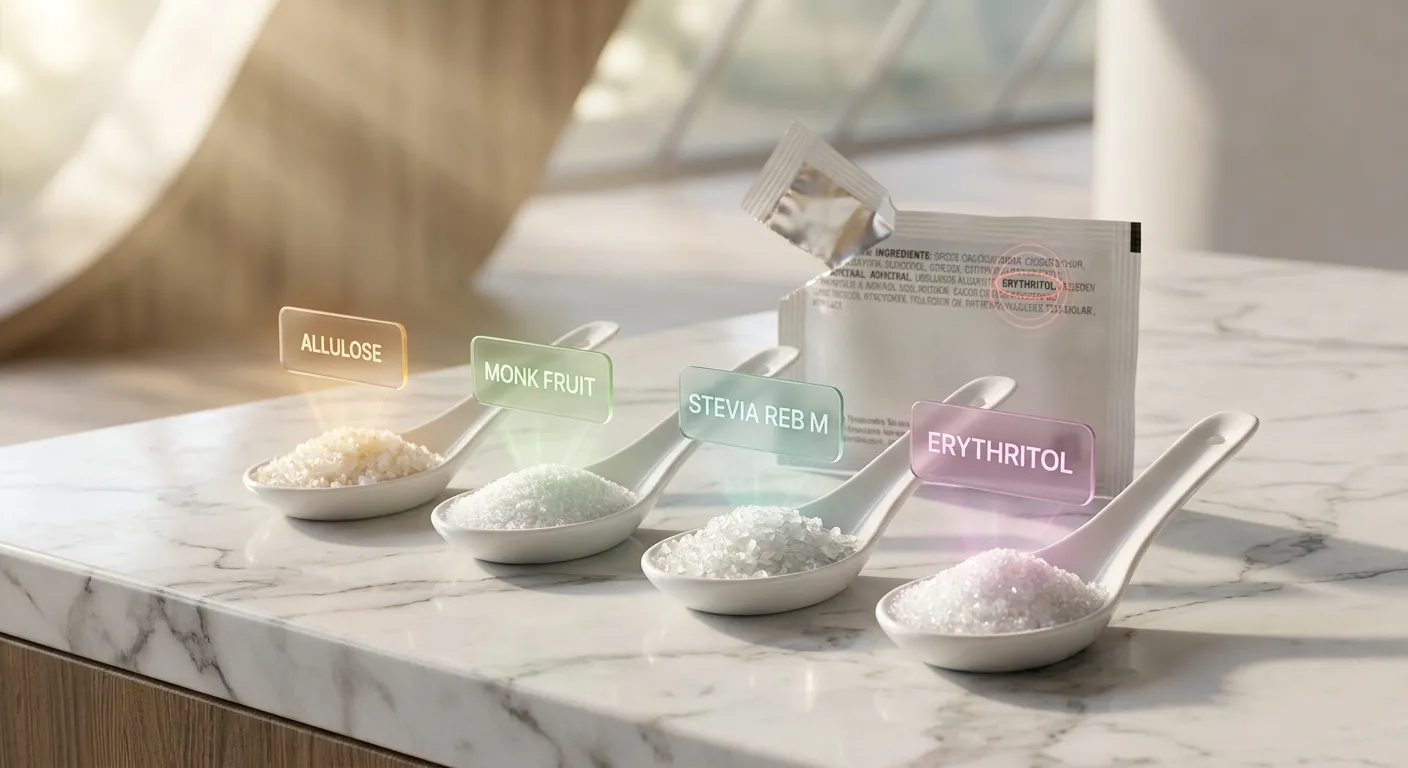
You are at Whole Foods. Three packets of "Monk Fruit Sweetener" sit on the shelf. Each one says "Zero Calorie." Each one says "Natural." The prices are $7.99, $12.99, and $19.99. You flip the cheapest one over: ingredient list reads Erythritol, Monk Fruit Extract. The middle one: Erythritol, Monk Fruit Extract. The most expensive: Allulose, Monk Fruit Extract.
So which packet is actually the monk fruit sweetener?
None of them. They are all bulk sweeteners with a sprinkle of monk fruit on top, and the bag is named after the rare ingredient because "Erythritol Sweetener" does not move units.
The 2026 sweetener aisle is messier than it has ever been. Erythritol has a cardiovascular cloud over it after the 2023 Nature Medicine paper and its 2025 ARIC follow-up. Allulose dodged FDA "Added Sugars" labeling and ate erythritol's reformulation lunch. Stevia split into a cheap-bitter camp (Reb A) and an expensive-clean camp (Reb M). Monk fruit became a marketing veneer for whichever bulk sweetener the brand had on hand.
Here is the honest 2026 ranking.
The Short Answer
For baking and ice cream: Use allulose. It browns, caramelizes, scoops, and stays soft. Nothing else does all four.
For coffee, tea, and a packet on the table: Use monk fruit blended with allulose, or pure monk fruit drops. Avoid blends where erythritol is the first ingredient if you are watching cardiovascular risk.
For sodas and ready-to-drink beverages: Manufacturers reach for stevia Reb M because it has the cleanest finish in cold acidic liquids. As a consumer, this is the one most likely to taste like sugar straight from a can.
For keto, GLP-1 maintenance, and diabetic management: All four have a glycemic index near zero. Differences are about gut tolerance and long-term safety, not blood sugar.
The packet trap: Most "monk fruit" packets are 99% erythritol or allulose by weight. Read the back of the bag, not the front.
Use Food For You to scan a sweetener bag and instantly see the real ingredient breakdown, the bulk-sweetener share, and any hidden additives. Register here to start scanning.
The Quick Comparison Table
This is the table to bookmark. It is built from FDA tolerance data, manufacturer specs, and the 2026 CSPI safety review.
| Property | Allulose | Monk Fruit (pure) | Stevia (Reb M) | Erythritol |
|---|---|---|---|---|
| Sweetness vs sugar | 0.7x | 150-250x | 200-350x | 0.6-0.8x |
| Calories | 0.4 kcal/g | 0 | 0 | 0.2 kcal/g |
| Glycemic index | 0 | 0 | 0 | 0 |
| FDA "Added Sugars" line | Excluded | Not applicable | Not applicable | Not applicable |
| Browns / caramelizes | Yes | No | No | No |
| Heat stable for baking | Yes (up to ~350°F) | Yes | Yes | Yes |
| Aftertaste | None | Slight cooling | Reb M: clean. Reb A: licorice/bitter | Cooling, mild |
| Daily gut limit (adult) | ~0.4 g/kg single dose, ~0.9 g/kg/day | None established | None established | ~0.5-0.8 g/kg before GI symptoms |
| 2026 safety status (CSPI) | Safe with GI caveat | Safest tier | Safest tier | "Uncertain — limit to a few grams/day" |
| Cost per cup-equivalent | High | Highest (pure) | High (Reb M), low (Reb A) | Lowest |
| Best use | Baking, ice cream | Coffee, packets | Beverages | Avoid as primary, fine in trace amounts |
A note on units: when this table says "0.7x sweetness," it means you need 1.4 cups of allulose to match 1 cup of sugar. For monk fruit at 200x, you need a teaspoon's worth to match a cup. The whole reason erythritol exists in commercial packets is to let intense sweeteners be measured by spoon instead of by grain.
Allulose: The New Favorite
Allulose bulk sales roughly doubled between 2023 and 2025 as food formulators raced out of erythritol after the Nature Medicine paper. By 2026 it has become the default reformulation sweetener for big brands.
The case for it is clean. It is a real sugar (the C-3 epimer of fructose, if you are curious) that occurs naturally in figs, raisins, jackfruit, and maple syrup. Your body absorbs about 70% of it, but it travels through the bloodstream and is excreted in urine without being metabolized for energy. So it tastes, browns, and bakes like sugar, but the FDA assigns it just 0.4 calories per gram instead of sugar's 4.
The "Added Sugars" exemption is the regulatory advantage that drives industry adoption. The FDA decided in 2019 that allulose, despite being a monosaccharide, did not need to appear on the "Added Sugars" or "Total Sugars" lines on the Nutrition Facts label. That guidance was finalized in 2020 and remains in effect under enforcement discretion as of 2026. So a yogurt sweetened with allulose can show 0g Added Sugars on the front-of-package label, while still tasting and behaving like sugar in the cup.
The catch is dose-dependent gastrointestinal tolerance. The 2018 Korean tolerance study found that healthy adults began to experience diarrhea, bloating, and abdominal pain at single doses around 0.4 g per kg of body weight (roughly 27 grams for a 150-pound adult, or about seven teaspoons in one sitting). Severe diarrhea kicked in at 0.5 g/kg. Spread across a day, the threshold is closer to 0.9 g/kg. In practice this means a sweetened coffee, a scoop of allulose ice cream, and a cookie in the same afternoon can put a sensitive eater over the edge.
Where it wins: baking, ice cream, BBQ glazes, anything that has to brown or stay scoopable. Substitute about 1.3 cups of allulose for 1 cup of sugar in cookies and cut the oven temperature 25°F because allulose browns faster than sucrose.
Where it does not: straight on the table. At 70% the sweetness of sugar, you would need an awkward amount per cup. That is the job of the next category.
Monk Fruit: What's In the Packet, Really?
Pure monk fruit extract is one of the more remarkable sweeteners on the market. The active compounds, mogrosides, are 150 to 250 times sweeter than sugar with no calories, no glycemic effect, and a clean profile. The Center for Science in the Public Interest puts monk fruit in its safest tier alongside stevia.
But that is the extract. Almost no one buys the extract. Pull a packet of "Lakanto Classic" or "Whole Earth Monk Fruit" or "Splenda Monk Fruit" off the shelf, and the back-of-bag ingredients tell you what is really inside.
Lakanto Classic: Erythritol, Monk Fruit Extract.
Whole Earth: Erythritol, Monk Fruit Extract, Stevia Leaf Extract.
Splenda Monk Fruit: Erythritol, Monk Fruit Extract.
By weight, the bulk sweetener is roughly 99% of what is in the bag. A 16-ounce bag of "monk fruit sweetener" contains maybe a teaspoon of actual monk fruit extract. The rest is erythritol carrying the volume so you can measure with a normal spoon. It is not dishonest, exactly. The bag does contain monk fruit. But when you pour a tablespoon of "monk fruit" into your coffee, you are mostly drinking erythritol.
If you accept that, monk fruit blends are fine. If you wanted monk fruit specifically because of the 2023 erythritol news, the marketing has misled you. Two responses:
-
Switch to a monk-fruit-and-allulose blend. Lakanto and a handful of newer brands now sell allulose-bulked versions. The bag will say Allulose, Monk Fruit Extract. These cost more but skip both the erythritol question and the GI issues people get from sugar alcohols.
-
Buy pure monk fruit drops or 1/64-teaspoon scoops. SweetLeaf, Lakanto, and NOW Foods all sell concentrated forms. A few drops sweetens a cup of coffee. The cost per use is actually lower than packet blends because the dose is so tiny.
The Compare mode in Food For You lets you photograph two "monk fruit" bags side by side and instantly see which is mostly erythritol and which is the cleaner allulose blend. The bulk sweetener is the product. The label tries to make you forget that.
Stevia: Old Reliable, Aftertaste Aside
Stevia is the longest-running natural high-intensity sweetener in the modern wave. The active compounds are steviol glycosides extracted from Stevia rebaudiana leaves. They are 200 to 350 times sweeter than sugar, calorie-free, and have been on the GRAS list since 2008.
The thing most consumers do not realize is that "stevia" is not one molecule. It is a family. Two of them dominate the market and they taste meaningfully different.
Rebaudioside A (Reb A) is the abundant glycoside, easy to extract, and roughly 250x as sweet as sugar. It is the cheapest steviol glycoside on the market and the one in most older stevia products (Truvia's original formulation, generic store-brand stevia). Its tradeoff: a noticeable bitter, licorice-tinged aftertaste that worsens at higher concentrations. Sensory panels consistently rate Reb A as more bitter than sucrose at equivalent sweetness.
Rebaudioside M (Reb M) is the premium glycoside and the reason stevia has gotten meaningfully better since around 2022. It is present at less than 0.1% of the leaf naturally, so commercial Reb M is produced via fermentation. The taste is dramatically cleaner. Sensory studies find Reb M nearly indistinguishable from sucrose for in-mouth sweetness, with minimal bitter lingering. The catch is that Reb M is roughly 10 times more expensive than Reb A.
This split is why the same brand can taste completely different across product lines. Coca-Cola's stevia-sweetened cola uses Reb M for the cleaner finish. A bag of generic supermarket stevia probably uses Reb A and tastes like licorice in your tea. Read the ingredient list: better products will specify "Rebaudioside M" or "Reb M."
For consumer use:
- Beverages (especially cold and acidic) — Reb M is the gold standard.
- Coffee — either works, but Reb A's bitterness fights the bean less than you would expect because coffee is already bitter.
- Baking — works but does not bulk up dough; combine with allulose or a small amount of sugar for structure.
- Yogurt and dairy — use sparingly. Stevia's aftertaste is more obvious in fat-free dairy.
CSPI puts stevia (any glycoside) in its safest tier. Acceptable Daily Intake set by the JECFA (Joint FAO/WHO Expert Committee) is 4 mg/kg body weight per day of steviol equivalents — far more than any human realistically consumes.
Erythritol's 2023 Heart Concern, Three Years Later
The headlines were ugly. The science is more nuanced. Here is where the evidence actually sits in 2026.
In February 2023, Witkowski et al. published a paper in Nature Medicine titled "The artificial sweetener erythritol and cardiovascular event risk." Across three independent cohorts totaling about 4,000 patients undergoing cardiac evaluation, higher blood erythritol levels were associated with significantly higher rates of major adverse cardiovascular events (heart attack, stroke, death) over three years. The fourth-quartile vs first-quartile hazard ratio was 1.80 in the US cohort and 2.21 in the European cohort. The authors also showed in vitro that erythritol enhanced platelet activation and clot formation.
The headlines in 2023 were brutal for erythritol. "Sugar substitute linked to heart attacks." Some keto influencers banned it overnight.
What has happened since:
Replication, partial. A 2025 ARIC Study analysis published in JACC: Advances found a similar association between blood erythritol levels and cardiovascular outcomes in older adults without prior cardiac disease. This strengthens the observational signal. The critical caveat: neither study measured how much erythritol participants ate. Both measured what was in their blood. Your body produces erythritol endogenously from glucose via the pentose phosphate pathway, especially under metabolic stress, so high blood erythritol may be a marker of underlying metabolic disease rather than a cause of clots.
Mendelian randomization. A 2024 study in Diabetes used genetic variants associated with erythritol metabolism and found a possible causal link to cardiometabolic disease. This is suggestive but not definitive — Mendelian randomization is one tool among several.
FDA review. The FDA published an evaluation acknowledging the Witkowski findings warrant further investigation, but did not change erythritol's GRAS status. No regulatory action has been taken.
CSPI update. The Center for Science in the Public Interest moved erythritol from "safe" to "uncertain," recommending a ceiling of "no more than a few grams a day" while research continues. This is the most honest summary of where the evidence sits in 2026: a real signal that needs more controlled human trials, but not enough to declare erythritol dangerous for the general population.
The framing we use: if you have cardiovascular risk factors (diabetes, prior heart event, high LDL, family history), reducing erythritol intake is reasonable and low-cost. If you are healthy and you eat a packet of erythritol-sweetened gum once a week, the data does not justify panic. Avoid the very-high-dose pattern that drove a lot of early keto culture — half a cup in a single keto dessert recipe — until controlled trials are published.
The Verdict by Use Case
Baking cookies, brownies, cakes: Allulose, full stop. It browns, stays soft, and produces a final product that tastes closer to a sugar bake than any other zero-calorie alternative. Reduce oven temperature 25°F and use 1.3 cups of allulose per cup of sugar called for.
Ice cream, sorbet, frozen desserts: Allulose, again. It does not crystallize, which means scoopable rather than rock-hard. Erythritol is the worst here — it causes a sandy mouthfeel and a freezer-burn texture.
Coffee and tea: Pure monk fruit drops or a monk-fruit-allulose blend. Stevia Reb M works if you can find a single-ingredient version. Avoid stevia Reb A in delicate teas.
Soda and sparkling beverages: Stevia Reb M is what you want in a sweetened seltzer. The cleaner finish in cold acidic liquids is real.
Keto: Allulose for cooking, monk fruit drops for the table. The 2024-2026 shift away from heavy erythritol use in keto baking is good news — you get the same sweetness without the sandy mouthfeel or the cardiovascular question mark.
GLP-1 (Ozempic, Mounjaro, Zepbound) maintenance: Any of the four. The blood sugar response is near zero across all of them. Stick to small portions; GLP-1 medications slow gastric emptying, which makes the dose-dependent GI effects of allulose and erythritol more noticeable. Start at half your usual amount.
Pregnancy, children, or chronic conditions: Talk to your doctor. CSPI specifically notes that low-calorie sweeteners have not been adequately tested in children, and individuals with IBS or other GI conditions react at lower doses than the general population.
How to Read a Sweetener Label and Spot the Blend Trick
This is the section to use the next time you are standing in front of a wall of "natural sweetener" packets.
Step 1: Ignore the front of the bag. Names like "Monk Fruit Sweetener" or "Stevia in the Raw" tell you the sales angle, not the ingredient breakdown.
Step 2: Read the ingredient list. Ingredients are listed in descending order by weight. The first ingredient is the bulk of what you are eating.
- Erythritol, Monk Fruit Extract — This is an erythritol product. Acknowledge it, decide if you are okay with that.
- Allulose, Monk Fruit Extract — Cleaner blend, no sugar alcohol, more expensive.
- Maltodextrin, Sucralose — This is a sucralose product (Splenda yellow packets). Maltodextrin has a glycemic index of 100+, almost as high as glucose. The "0 calorie" claim survives because the per-packet amount is below FDA rounding rules. Drink eight a day and you have eaten meaningful glucose.
- Erythritol, Stevia Leaf Extract — Stevia carrier, similar to monk fruit blends.
- Rebaudioside M — Pure stevia, premium. This is what you want in a Reb M product.
- Rebaudioside A — Cheaper stevia, expect aftertaste.
Step 3: Check the cooling effect. Erythritol has a measurable cooling sensation in the mouth, like a mild mint without the mint. Allulose, monk fruit, and stevia do not. If your "monk fruit" packet feels cold, it is mostly erythritol.
Step 4: Run the math on the per-cup volume. A pure monk fruit or stevia extract is 200x as sweet as sugar. If a "1:1 sugar replacement" bag claims to substitute 1 cup for 1 cup of sugar, the bulk is ~99% bulk sweetener. There is no mathematical way to avoid this with high-intensity extracts.
Food For You's scanner reads sweetener labels and breaks down what percentage of the packet is the headline ingredient versus the bulk filler. Useful for the grocery aisle and useful for breaking the habit of trusting the front of the bag.
A Brief Note on Aspartame
Aspartame (Equal, NutraSweet, the blue packet) is technically nutritive — 4 calories per gram — but used at such low doses that it functions as zero-calorie. It sits in a different category from the four sweeteners covered here, more comparable to sucralose and saccharin. The WHO/IARC reclassified aspartame as "possibly carcinogenic to humans" (Group 2B) in July 2023 based on limited evidence in humans. The classification was widely covered and widely contested by the EFSA and FDA, both of which left their safety thresholds unchanged. We mention it here only to anchor the comparison: aspartame and sucralose are not in the natural-sweetener conversation that drives most of the 2026 product reformulations, and a deeper look at them belongs in a separate post.
Conclusion
The pragmatic 2026 recommendation: make allulose your default cooking sweetener and pure monk fruit extract your default table sweetener. Use stevia Reb M when the application calls for cold beverages. Treat erythritol the way you would treat a borderline ingredient. Fine in trace amounts in pre-packaged foods. Not the right choice when you have to buy a bag for the pantry, especially if your cardiovascular history points that way.
The deeper lesson is that the front of the sweetener bag is marketing. The back is engineering. A "monk fruit sweetener" that is 99% erythritol is technically truthful and practically misleading. The skill of reading sweetener labels in 2026 is the same skill we wrote about in our nutrition-label guide: ignore the claims, read the ingredients, run the math.
Use Food For You to scan any sweetener bag and instantly see the real ingredient breakdown, the bulk-sweetener share, the Health Score (0-100), and the NOVA classification. The app shows what the front of the bag is built to hide.
Create your free account today and stop buying sweeteners by the marketing.
References
- Center for Science in the Public Interest. Which low-calorie sweeteners are safe — and which aren't? Retrieved from https://www.cspi.org/article/which-low-calorie-sweeteners-are-safe-and-which-arent
- Witkowski, M., Nemet, I., et al. (2023). The artificial sweetener erythritol and cardiovascular event risk. Nature Medicine, 29, 710-718. Retrieved from https://www.nature.com/articles/s41591-023-02223-9
- Abushamat, L., Yu, B., Hoogeveen, R., et al. (2025). Erythritol, Erythronate, and Cardiovascular Outcomes in Older Adults in the ARIC Study. JACC: Advances, 4(3). Retrieved from https://www.jacc.org/doi/10.1016/j.jacadv.2025.101605
- U.S. Food and Drug Administration. Guidance for Industry: The Declaration of Allulose and Calories from Allulose on Nutrition and Supplement Facts Labels. Retrieved from https://www.fda.gov/regulatory-information/search-fda-guidance-documents/guidance-industry-declaration-allulose-and-calories-allulose-nutrition-and-supplement-facts-labels
- Han, Y., Choi, B. R., Kim, S. Y., et al. (2018). Gastrointestinal Tolerance of D-Allulose in Healthy and Young Adults. A Non-Randomized Controlled Trial. Nutrients, 10(12), 2010. Retrieved from https://pmc.ncbi.nlm.nih.gov/articles/PMC6315886/
- Tang, Y., Zhang, Y., et al. (2020). Consumer-Based Sensory Characterization of Steviol Glycosides (Rebaudioside A, D, and M). Foods, 9(8), 1026. Retrieved from https://pmc.ncbi.nlm.nih.gov/articles/PMC7466183/
Frequently Asked Questions
Team Food For You
Reviewed by: Dr. Arthur Price
The Food For You team combines AI technology with nutrition science to help people make safer, healthier food choices.
Learn more about usMedical Disclaimer
The content provided in this blog is for informational purposes only and does not constitute medical advice. Always consult with a qualified healthcare professional for diagnosis and treatment of allergies.
Related Articles
Ultra-Processed Food: The 4 Legal Definitions of 2026
No official US definition of ultra-processed food exists yet, just four competing ones. What NOVA, the FDA white paper, California and Arizona each say in 2026.
Is It Ultra-Processed? 30 Foods Decoded
A food-by-food NOVA verdict for 30 things in your cart: sourdough vs. supermarket loaf, RXBAR vs. Quest, oat milk vs. barista oat. With the why.
8 Food Dyes Being Phased Out by 2026
The FDA's 2026 phase-out targets 8 petroleum dyes — but it's voluntary, deadlines are slipping to 2027, and major brands haven't budged. Here's how to spot every dye on a label tonight.
