How Much Protein Do You Actually Need? 2026 Guide
Key Takeaways
A by-age, evidence-based protein cheat-sheet for 2026 — what the science actually says about how many grams you need from infancy through your 80s, why timing matters as much as totals, and how to track your number with Food For You.
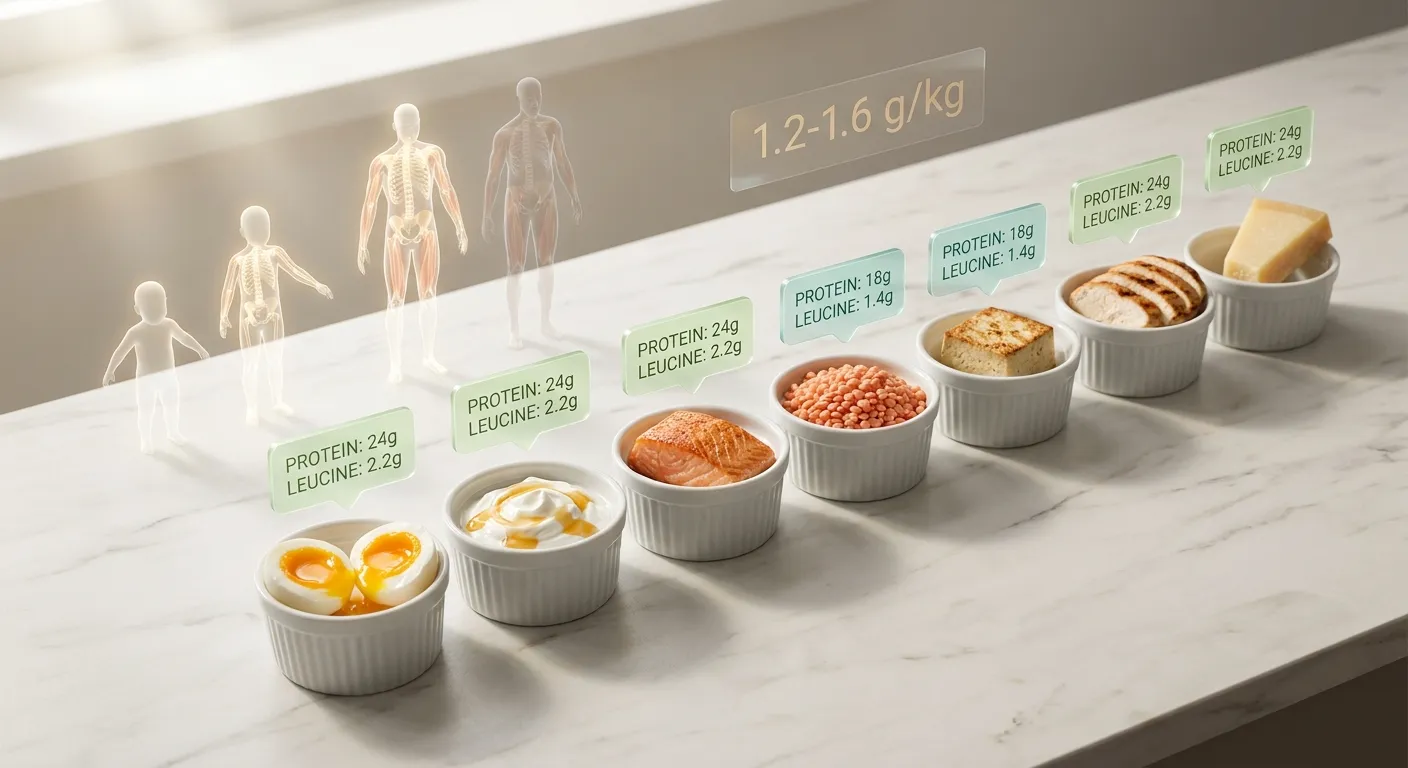
A woman in her late fifties asked her trainer how much protein she should be eating. He told her to aim for 110 grams a day. She laughed — that was more than her teenage son ate. Then she logged a normal week: oatmeal, a salad with chicken, salmon with rice, yogurt before bed. The total came out to 58 grams a day. Almost exactly half her target.
She is not unusual. She is the median.
The number most adults still quote — 0.8 grams of protein per kilogram of body weight — was set by a 1968 WHO committee and locked into the US Recommended Dietary Allowance shortly after. It was designed to answer one question: how little protein can a young, healthy man eat without slipping into nitrogen balance deficit? That answer is not the same as the answer to a much more useful question: how much protein does an aging body need to keep muscle, support bone, recover from training, and not feel hungry at 4pm?
This guide pulls the 2024-2026 evidence into a cheat-sheet you can use in about a minute. Find your row, do the multiplication, and you have a target that reflects what the research actually says rather than what a 1960s nitrogen-balance study could measure.
The Short Answer: Your Number by Age
If you only have thirty seconds, find your row, multiply by your weight in kilograms (your weight in pounds ÷ 2.205), and you have your daily floor.
| Life stage | Evidence-based range | Notes |
|---|---|---|
| Infants (0-12 mo) | 1.5 g/kg | Breast milk or formula covers this naturally. |
| Toddlers (1-3) | 1.1 g/kg | Small bodies, fast growth. |
| Kids (4-13) | 0.95 g/kg | Tracks growth, not size. |
| Teens (14-18) | 0.85 g/kg | Higher in athletes (1.2-1.6 g/kg). |
| Adults (19-50), sedentary | 1.0-1.2 g/kg | Floor for general health. |
| Adults (19-50), active | 1.4-1.6 g/kg | Recreational training, hiking, lifting. |
| Adults (19-50), serious strength | 1.6-2.2 g/kg | Hypertrophy, body recomposition. |
| Older adults (51-70) | 1.2-1.5 g/kg | Sarcopenia prevention starts here. |
| Older adults (71+) | 1.5-2.0 g/kg | Higher target due to anabolic resistance. |
| Pregnant (2nd/3rd trimester) | +25 g over baseline | Discuss with your OB. |
| Breastfeeding | +25 g over baseline | Sustains milk supply. |
A 70 kg (154 lb) active 35-year-old: 70 × 1.5 = 105 g per day. A 65 kg (143 lb) active 72-year-old: 65 × 1.7 = 110 g per day. Notice how close those are — that's the point. Protein needs change more across life stages than across people of the same age.
Quick check: the Food For You app logs every meal's protein, fiber, and added sugar with one photo of the label or the plate. If you're guessing, you're almost certainly under. Register here to start tracking.
The 0.8 g/kg Number Is From 1968. Here's What Changed.
The 0.8 g/kg figure comes from nitrogen balance studies done on young adult men in the 1960s and 1970s. Researchers fed subjects different amounts of protein and measured nitrogen excretion in urine and stool. The lowest intake at which subjects didn't lose more nitrogen than they took in became the Estimated Average Requirement. Add a safety margin, and you get the RDA: 0.8 g/kg.
Three problems with treating that as a target for modern adults.
First, nitrogen balance is a survival metric. It tells you when someone is wasting away. It says nothing about building muscle, maintaining bone, or staying full past 3pm.
Second, the studies were short. Most lasted 7-14 days. People can stay in nitrogen balance on a low-protein diet for that long while still slowly losing lean mass.
Third, the subjects were young. Anabolic resistance — the reduced ability of older muscle to respond to dietary protein — wasn't measured. It's now one of the most replicated findings in nutritional gerontology: the same 20 g of protein that triggers a strong muscle-building signal in a 25-year-old produces a blunted response in a 70-year-old.
The PROT-AGE consensus, the 2023 ESPEN clinical guidelines for older adults, and randomized trials from Stuart Phillips's lab at McMaster all point the same direction: the RDA underestimates real needs for adults past their twenties, and badly underestimates them past sixty.
Protein Needs by Age, Decoded
Infants and toddlers (0-3)
Roughly 1.1-1.5 g/kg per day, dropping steadily as growth slows. A typical breastfed infant gets 1.5 g/kg from milk alone — this is one of the few life stages where the math takes care of itself. Once solids enter the picture, eggs, yogurt, beans, and small pieces of soft meat or fish do the work. Toddlers don't need supplements. They need protein at multiple eating windows, because their stomachs are small and their growth is constant.
Kids (4-13)
About 0.95 g/kg. A 25 kg (55 lb) seven-year-old needs roughly 24 g of protein a day, which a single egg + a cup of milk + a small chicken thigh covers. The bigger issue at this age isn't quantity — most kids in industrialized countries hit it easily — but quality and timing. Sugary "kid food" displaces protein-dense breakfasts. If your child eats a fruit pouch and a granola bar for breakfast, they're likely starting their day with under 6 g of protein, then catching up at dinner.
Teens (14-18)
0.85 g/kg for sedentary teens, 1.2-1.6 g/kg for active ones. Adolescence is the second-fastest growth window of life, and skeletal mass laid down during the teenage years sets the ceiling for lifetime bone strength. Vegetarian and vegan teens need particular attention to leucine sources (soy, lentils, quinoa, supplemented plant proteins) since plant proteins generally have a lower DIAAS score (see below).
Young and middle adults (19-50)
This is the range where the RDA does the most damage.
- Sedentary adults: floor is 1.0-1.2 g/kg. Practical target.
- Recreationally active adults (3-5 workouts a week, daily walking): 1.4-1.6 g/kg. This is the sweet spot for most readers of this article.
- Strength training for body composition: 1.6-2.2 g/kg. The upper end is rarely needed unless you're in a deliberate cutting phase.
Two recent papers worth knowing: the 2020 BMJ meta-analysis of 32 cohort studies found that higher total protein intake was associated with lower all-cause mortality, with the strongest effect coming from plant protein. And a 2024 Cell Metabolism review confirmed that adults eating 1.2-1.6 g/kg gained more lean mass and lost more fat on identical calorie deficits than adults eating the RDA.
Older adults (51+) — the sarcopenia inflection point
This is the inflection point of the whole guide.
Around age 50, three things change at once. Skeletal muscle starts losing about 1% of its mass per year. Anabolic resistance reduces the muscle-building signal from any meal. And appetite quietly drops — most adults eat 10-15% less in their seventies than they did in their forties.
PROT-AGE and ESPEN both recommend 1.2-1.5 g/kg for healthy older adults, climbing to 1.5-2.0 g/kg for those recovering from illness or surgery, or showing signs of frailty. A 2024 Nature Aging paper found that in adults over 65, eating below 1.2 g/kg was independently associated with a 30% higher risk of incident frailty within five years, even after adjusting for calories, activity, and chronic disease.
Midlife women are the most under-served group in this conversation. Estrogen loss accelerates muscle protein breakdown and bone turnover. A 58-year-old, 65 kg woman eating the RDA (52 g/day) is undereating protein by 40-60% by every modern guideline. If you are this person, you are not alone — you are typical.
Pregnancy and lactation
Roughly +25 g/day above your pre-pregnancy baseline in the second and third trimester and during breastfeeding, per the IOM and 2023 ACOG guidance. The first trimester usually doesn't require extra protein. These figures should be discussed with your OB or midwife, especially in twin pregnancies or in gestational diabetes management, where individualized targets often run higher.
The Activity Multiplier
Activity bumps the target upward, and the type of activity matters more than the duration.
| Activity profile | Multiplier (g/kg) | Example |
|---|---|---|
| Sedentary office worker | 1.0-1.2 | < 5,000 steps a day |
| General fitness | 1.2-1.4 | 3 cardio sessions a week |
| Endurance training | 1.4-1.7 | Marathon, triathlon, century rides |
| Strength training (maintenance) | 1.6-2.0 | 3-4 lifting sessions a week |
| Strength training (hypertrophy or cut) | 1.8-2.2 | Deliberate body recomposition |
| Older adult + resistance training | 1.5-2.0 | The strongest evidence base of all |
A common mistake is bumping protein up for endurance training but down for "rest days." Muscle protein synthesis runs on a 24-48 hour cycle. Hitting your number is a daily habit, not a workout-day habit.
Distribution Beats Total: Why 30 g × 4 Beats 120 g at Dinner
The single most actionable finding from the last decade of protein research: how you spread protein across the day matters as much as how much you eat.
Muscle protein synthesis (MPS) is triggered by a leucine threshold — roughly 2.5-3 g of leucine in a single meal, which corresponds to about 25-30 g of high-quality protein for younger adults and 35-40 g for adults over 60. Below that threshold, MPS doesn't really turn on. Above it, you get diminishing returns from any further protein in that same meal.
The implications are blunt:
- A 120 g protein dinner maxes out the synthesis signal once. Most of the protein gets used for energy or stored, not muscle.
- Four meals of 30 g each trigger the synthesis signal four times. Same daily total, much better muscle outcome.
Mamerow and colleagues, working in Doug Paddon-Jones's lab, fed two groups the same 90 g of protein per day for a week — one skewed toward dinner (10/15/65 g across breakfast, lunch, dinner), the other split evenly (30/30/30). The even group ran 24-hour muscle protein synthesis about 25% higher. The total intake was identical; the distribution did the work.
Practical rule of thumb: build every meal around a palm-sized protein anchor (chicken, fish, tofu, eggs, Greek yogurt, lentils, cottage cheese). Snacks count toward the day's total but rarely cross the leucine threshold on their own.
Protein Quality: DIAAS, Leucine, and Plant vs. Animal
Not all 30 g of protein are nutritionally equivalent. Two foods with identical protein content on the label can deliver wildly different amounts of usable amino acids.
The current gold standard for measuring this is DIAAS — the Digestible Indispensable Amino Acid Score, adopted by the FAO in 2013. A DIAAS of 100 means the food provides all essential amino acids at the levels a human body needs. Below 100, one or more amino acids is the limiting factor.
| Food (30 g protein serving) | DIAAS | Leucine | Notes |
|---|---|---|---|
| Whole egg | 113 | 2.5 g | Reference standard |
| Milk (whey + casein) | 114 | 2.9 g | Highest digestibility |
| Beef | 112 | 2.6 g | Includes iron and B12 |
| Chicken breast | 108 | 2.3 g | Lean, leucine-rich |
| Greek yogurt (plain) | 100+ | 2.7 g | See our Greek vs regular breakdown |
| Soy protein isolate | 98 | 2.3 g | The plant gold standard |
| Tofu | 87 | 1.9 g | Solid choice in mixed meals |
| Pea protein | 73 | 2.1 g | Leucine is OK, methionine is low |
| Black beans | 59 | 1.6 g | Pair with rice for completeness |
| Wheat (seitan) | 40 | 1.5 g | Low lysine — limiting amino acid |
Two takeaways. First, animal proteins generally hit the leucine threshold in smaller serving sizes — useful for older adults eating less overall. Second, plant-based eaters don't need to chase DIAAS perfection at every meal; combining sources across the day (lentils + rice + a soy-based product, say) produces a complete amino acid profile that works just fine for muscle and health outcomes, supported by the 2020 BMJ mortality data. Plant-protein eaters generally need to aim about 10-20% higher in total grams to compensate for lower average digestibility.
Are You Actually Hitting Your Number?
If you've never tracked, you're probably not. Self-report nutrition surveys overestimate protein by 10-20%, and the gap is widest in adults over 50.
Signs you might be under:
- Hair shedding more than usual, slow nail growth, skin that resists moisturizers.
- Stalled training progress despite consistent workouts — you train, but you don't recover.
- Persistent late-afternoon hunger — satiety hormones (GLP-1, PYY, CCK) didn't clock in because the meal that should have triggered them was short on protein.
- Slower recovery from minor injuries, frequent muscle cramps, visibly thinner limbs than a decade ago.
None of these are diagnostic on their own. Tracking for a week is.
Logging a week of meals in Food For You gives you a real protein number — not a guess. Every scanned product, whether from a label or a plate photo, contributes to a daily total, and each meal gets a Health Score from 0 to 100 so you can spot the weak ones. The NOVA classification layer makes sure you're not hitting your protein target with ultra-processed shakes and "high-protein" candy. Quality and quantity in the same screen.
Special Cases Worth a Line
Chronic kidney disease (CKD) and dialysis. Higher protein intakes are not appropriate. CKD patients typically need 0.6-0.8 g/kg under a nephrologist's supervision, and dialysis has its own protocol. The targets in this guide do not apply to you — please talk to your renal team before changing anything.
Low-carb or keto diets. Keto plans run higher in protein than the original 1920s ketogenic protocol, but generally stay in the 1.2-1.7 g/kg range. If you want the broader context, our Keto 2.0 piece covers what to keep and what to drop.
GLP-1 medications (semaglutide, tirzepatide). Rapid weight loss on Ozempic, Wegovy, Mounjaro, or Zepbound includes substantial lean-mass loss — up to 40% of the total weight lost can be muscle if protein isn't managed. People on these medications generally need to increase relative protein intake (often to 1.6-2.0 g/kg of goal weight) to protect muscle. Our GLP-1 nutrition guide goes deeper. The catch: appetite suppression means eating protein on a schedule, not when you feel hungry.
Liver disease. Old advice was to restrict protein. Current guidance is mostly the opposite — cirrhosis patients lose muscle rapidly and benefit from 1.2-1.5 g/kg — but timing and amino acid composition need to be individualized with a hepatologist.
The numbers in this guide are evidence-based ranges for healthy adults. They are not personal medical advice. Bring them to your clinician.
Bottom Line
- The 0.8 g/kg RDA is a floor designed for young men in 1968, not a target for thriving adults in 2026.
- Most healthy adults thrive on 1.2-1.6 g/kg. Active adults and lifters go higher.
- Adults over 65 benefit from 1.5-2.0 g/kg — this is the strongest single recommendation in modern protein research.
- Distribution matters as much as total. Three or four meals each containing 25-40 g of high-quality protein beat one big-protein meal at the end of the day.
- Quality (DIAAS, leucine) matters too, especially for plant-based eaters and older adults.
- If you have kidney disease, are pregnant or breastfeeding, or are on GLP-1 medications, your number is different — get it from your clinician, not from a blog post.
Stop Guessing. Start Tracking.
Knowing your number is useful. Hitting it is the hard part. Food For You turns every meal photo or label scan into a clean breakdown of protein, fiber, added sugars, and processing level, then assigns a Health Score (0-100) and a NOVA classification so you can see at a glance whether you're hitting your daily target with whole foods or with high-protein junk. The diary view shows you each meal's protein anchor so you can fix the weak ones before the day is over.
Create your free account today and find out what your real number looks like.
References
- NIH Office of Dietary Supplements. Protein and Amino Acids — Health Professional Fact Sheet. ods.od.nih.gov
- PROT-AGE Study Group — Bauer J., Biolo G., Cederholm T., et al. (2013). Evidence-Based Recommendations for Optimal Dietary Protein Intake in Older People. JAMDA. Link
- Phillips S.M., Chevalier S., Leidy H.J. (2016). Protein "Requirements" Beyond the RDA: Implications for Optimizing Health. Applied Physiology, Nutrition, and Metabolism. Link
- Mamerow M.M., Mettler J.A., English K.L., et al. (2014). Dietary Protein Distribution Positively Influences 24-h Muscle Protein Synthesis in Healthy Adults. Journal of Nutrition. Link
- Naghshi S., Sadeghi O., Willett W.C., Esmaillzadeh A. (2020). Dietary intake of total, animal, and plant proteins and risk of all cause, cardiovascular, and cancer mortality. BMJ. Link
- USDA / HHS. Dietary Guidelines for Americans 2025-2030. DietaryGuidelines.gov
- ESPEN. (2022). Clinical Practice Guideline on Nutrition and Hydration in Geriatrics. Clinical Nutrition. Link
Frequently Asked Questions
Team Food For You
Reviewed by: Dr. Arthur Price
The Food For You team combines AI technology with nutrition science to help people make safer, healthier food choices.
Learn more about usMedical Disclaimer
The content provided in this blog is for informational purposes only and does not constitute medical advice. Always consult with a qualified healthcare professional for diagnosis and treatment of allergies.
Related Articles
The Fiber Gap: Fibermaxxing Without Fake Bars
The average American eats 15g of fiber a day. The target is 25-38g. Here's what 'fibermaxxing' actually means in 2026, and how to spot fake fiber on a label.

What to Eat on Ozempic & GLP-1: 2026 Guide
On Ozempic, Wegovy, or Mounjaro? You have ~30% of your old appetite and 40% of weight lost can be lean mass. Here's how to read labels for protein, fiber, and the new "GLP-1 Friendly" marketing trap.
Are Protein Bars Healthy? Top 10 Ranked
We analyzed the top 10 protein bar brands of 2026 using the NOVA scale. Find out which are real food and which are just candy in disguise.
