8 Food Dyes Being Phased Out by 2026
Key Takeaways
In April 2025 the FDA announced an "understanding" with industry to remove eight petroleum-based dyes by end of 2026. One year in, deadlines have quietly shifted to 2027, Coca-Cola and Mondelez have made no concrete pledges, and West Virginia's broader state ban is tied up in court. This guide names every dye, every alias, the categories where they hide, and what the evidence actually says about ADHD, cancer, and gut effects.
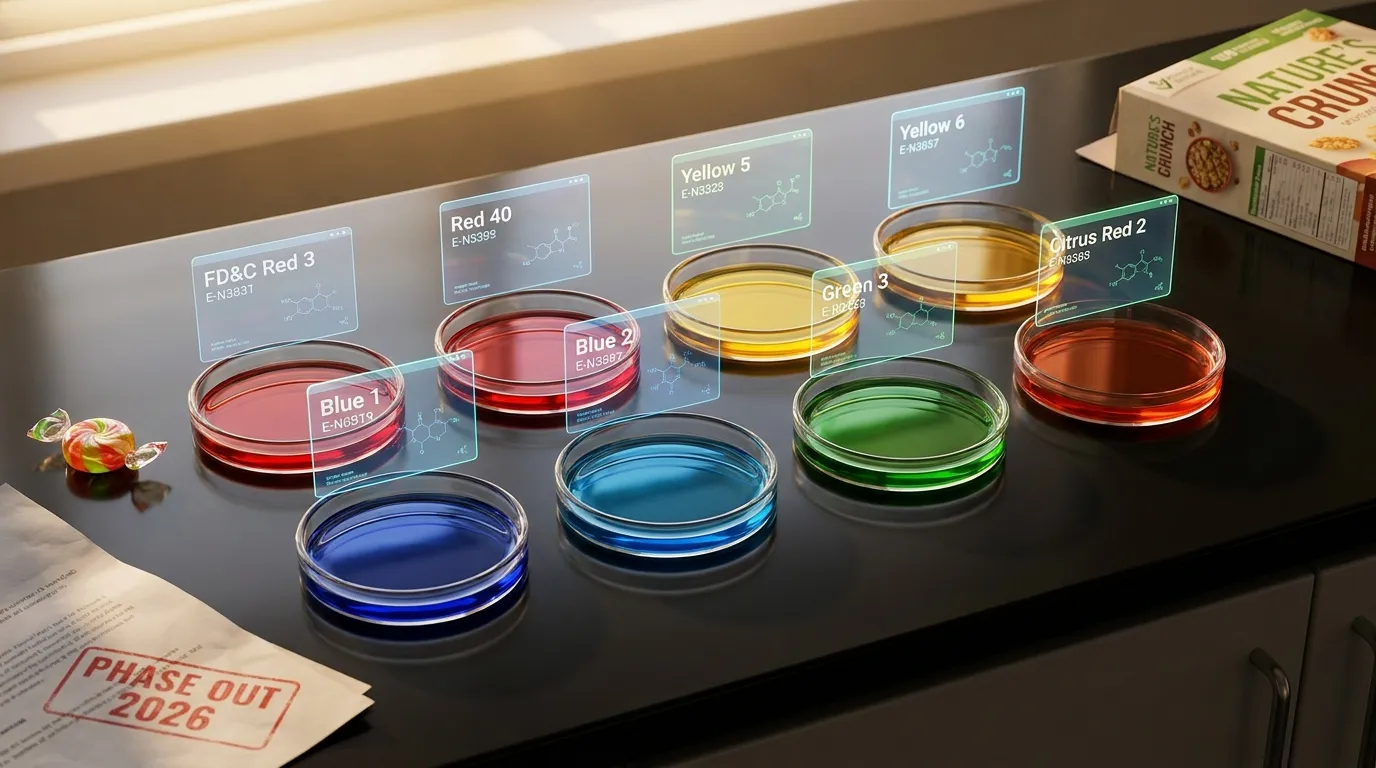
A father stands in the cereal aisle in late April 2026, holding two boxes of his kid's favorite breakfast. The old box is gone. The new one has the same mascot, a slightly muted palette, and a starburst that reads "Now naturally colored!" The ingredient list still runs eighteen lines deep. Two of those lines are "vegetable juice (color)" and "annatto extract." There is no FD&C anything. He is supposed to feel reassured.
He shouldn't. Or, more precisely: not yet.
On April 22, 2025, the U.S. Department of Health and Human Services and the FDA announced what most outlets called a "ban" on petroleum-based food dyes. It wasn't. It was a voluntary "understanding" with industry, paired with a target date of end-of-2026. One year in, that target has quietly shifted. The Consumer Brands Association, which represents most of the largest manufacturers, has pledged December 31, 2027. General Mills wants to be done with school cereals by summer 2026 and U.S. cereals by end of 2027. Campbell's targets the second half of fiscal 2026. Coca-Cola, Mondelez, and Unilever — three of the largest dye buyers in the country — have made no public commitment at all.
Meanwhile, the only dye with a hard federal deadline is Red No. 3, banned by a separate January 2025 rule under the Delaney Clause. That deadline is January 15, 2027 for food.
So the cereal box you're holding might be reformulated. It might be reformulated for school distribution and not for the regular shelf. It might still contain Yellow 5. Or it might be using beet juice that fades to brown by the time it reaches Phoenix in July. The label is still doing the work, and you still have to read it.
The Short Answer
Eight petroleum-based synthetic dyes are on the way out — but on industry's timeline, not the FDA's. Only Red No. 3 has a hard federal deadline (January 15, 2027 for food). The other seven — Red 40, Yellow 5, Yellow 6, Blue 1, Blue 2, Green 3, plus Citrus Red 2 and Orange B — are governed by voluntary pledges that have largely slipped from the 2026 announcement to end-of-2027. State laws in California, West Virginia, Utah, Virginia, and Arizona are filling part of the gap, but most apply only to schools or are tied up in court. Until then: search the ingredient list for "FD&C," any color-plus-number combination, or "Lake," and treat "no artificial colors" claims with skepticism — under February 2026 FDA guidance, that phrase now means "no petroleum dye," not "no added color."
1. The Eight Dyes: Names, Aliases, Where They Hide
If you're going to scan an ingredient list, you need to know what you're looking at. The same molecule can appear under at least three different names depending on the country, the regulator, and whether the manufacturer is using the soluble dye or the insoluble "Lake" pigment used to color tablets and candy shells.
| FDA Name | Common Name | E-Number | Color | Typical Products |
|---|---|---|---|---|
| FD&C Red No. 3 | Erythrosine | E127 | Bright pink-red | Maraschino cherries, candy melts, strawberry frosting, PediaSure (older formulations) |
| FD&C Red No. 40 | Allura Red AC | E129 | Orange-red | Skittles, Doritos Cool Ranch, Mountain Dew Code Red, kids' yogurt drinks, cold medicines |
| FD&C Yellow No. 5 | Tartrazine | E102 | Lemon yellow | Mountain Dew, Kraft mac and cheese (old formulation), Lucky Charms marshmallows, pickles |
| FD&C Yellow No. 6 | Sunset Yellow FCF | E110 | Orange | Cheetos, Doritos Nacho Cheese, Reese's Pieces, orange soda, boxed cake mixes |
| FD&C Blue No. 1 | Brilliant Blue FCF | E133 | Cyan blue | Blue M&M's, blue Powerade, some toothpastes, Pop-Tarts frosting |
| FD&C Blue No. 2 | Indigo Carmine | E132 | Royal blue | Blueberry Pop-Tarts (color blend), some pet foods, M&M's, capsule shells |
| FD&C Green No. 3 | Fast Green FCF | E143 | Teal | Canned peas (some brands), mint candy, sherbet — banned in the EU since 1984 |
| Citrus Red 2 | — | — | Orange | Allowed only on Florida orange peels (not pulp). Most consumers never see it listed. |
Two of the eight rarely appear in modern grocery items. Citrus Red 2 is permitted only as a peel-coloring on whole oranges grown in Florida. Orange B was approved for sausage casings; the FDA has not certified a batch since 1978, and it is functionally extinct. The first six are the ones that matter for a real grocery run.
A few label-reading shortcuts:
- "Lake" at the end of a color name (Red 40 Lake, Blue 1 Lake) means the aluminum-bonded, oil-dispersible version. Same dye, different physical form. Used in candy coatings, gum, and tablets.
- "FD&C" stands for Food, Drug, and Cosmetic Act. If you see it, the dye is on this list.
- E-numbers appear on imported European products — Skittles bought in Berlin, for example, list E129 instead of "Red 40."
- "Color added" with no further detail is allowed for some natural-source colors but is not allowed for the synthetic dyes in this table. They must be named.
2. What the Evidence Actually Shows
The dye conversation in 2026 is loud and often imprecise. Here is the evidence in three tiers.
Red No. 3 and the Delaney Clause
The 2025 federal action on Red 3 was a legal mechanism, not a new science finding. Two studies from the 1980s, including a 1987 study, showed thyroid tumors in male rats fed high doses. The FDA, EFSA, JECFA, and Australia's FSANZ all concluded the mechanism is rat-specific and not relevant to humans at typical exposure. But the Delaney Clause of the Federal Food, Drug, and Cosmetic Act is unforgiving: any color additive shown to induce cancer in any animal model must lose its food authorization. The 2025 revocation was effectively the FDA being forced to apply its own 1960 statute, decades after the EU restricted Red 3 to certain processed cherries in 1994.
The ADHD signal
Three meta-analyses dominate the academic literature.
- Schab and Trinh (2004) found a modest but significant effect of artificial colors on hyperactivity in clinically sensitive children.
- Nigg et al. (2012) found a parent-reported effect size of g = 0.18 across high-quality studies, surviving correction for publication bias. The authors estimated roughly 8% of children with ADHD may have symptoms related to synthetic colors.
- The California OEHHA 2021 health-effects assessment, a systematic review of 27 clinical trials, found behavioral changes in 64% of studies and statistically significant changes in 52%.
This is not "dyes cause ADHD." It is closer to "dyes produce a small, real attention effect in a subset of children, and current Acceptable Daily Intakes were set in the 1970s and 1980s using endpoints that did not include neurobehavior." EFSA and JECFA have re-reviewed the same data and concluded current intake levels are safe. The UK asked manufacturers to remove the dyes voluntarily in 2008. The EU requires a warning label on products containing six of the eight: "may have an adverse effect on activity and attention in children." No such warning exists in the U.S.
Gut and emulsifier effects
This is the area most likely to grow. Several 2020s studies on emulsifiers and azo dyes (Red 40 and Yellow 5 and 6 are azo dyes) suggest interactions with the gut microbiome and the intestinal mucus layer. The mechanism research is preliminary. None of it has driven regulation yet. File it under "watch this space."
If you are scanning labels for a child with a confirmed sensitivity, treat the European warning standard as your floor. Avoiding Red 40, Yellow 5, Yellow 6, Blue 1, Blue 2, and Green 3 covers the dyes the EU singled out.
3. The "Voluntary" Loophole
The April 2025 announcement framed the phase-out as a partnership. In practice, it is a tracker. The FDA maintains a public portal cataloging which companies have pledged what, and by when. As of April 2026, here's where the major commitments sit:
- General Mills — All certified color additives out of U.S. cereals and K-12 school foods by summer 2026; full U.S. portfolio by end of 2027.
- Kraft Heinz — Public commitment, no firm date for full U.S. portfolio.
- Conagra, Nestle USA, PepsiCo, Tyson Foods — Commitments to remove dyes; specifics vary.
- Mars — "Product options without certified colors starting in 2026." Note the word options. Skittles and M&M's still ship with Red 40, Yellow 5, Yellow 6, Blue 1, and Blue 2 in late April 2026.
- Campbell's — No FD&C colors in any food or beverage by second half of fiscal 2026.
- Consumer Brands Association (trade group) — Voluntary December 31, 2027 industry-wide target.
- International Dairy Foods Association — Synthetic dyes out of ice cream by end of 2027 (companies representing roughly 90% of U.S. ice cream sales).
- Coca-Cola, Mondelez, Unilever — No concrete public commitment as of late April 2026.
The pharmaceutical industry has openly resisted. PhRMA, the trade association, submitted comments urging the FDA not to ban synthetic dyes in drugs, arguing that color helps patients distinguish between pills. Consumer Reports, surveying the field in March 2026, could not find a single major drug company with a public phase-out plan.
State law has done more concrete work than the federal announcement.
- California AB 418 bans Red 3, brominated vegetable oil, potassium bromate, and propylparaben from any food sold in the state starting January 1, 2027.
- California AB 2316 removes Red 40, Yellow 5, Yellow 6, Blue 1, Blue 2, and Green 3 from public schools by December 31, 2027.
- West Virginia HB 2354 is the most aggressive: seven dyes plus BHA and propylparaben in all foods and drugs sold in the state, school start in August 2025, full ban January 1, 2028. As of March 2026, parts of the law are blocked by a state judge, and a fix bill died in the Senate after legislators tried to exempt West Virginia-made pepperoni rolls and popsicles.
- Utah, Virginia, Arizona — School-only restrictions, phased in 2025–2027.
That's the reality behind the headlines. The dyes are leaving on a fragmented, uneven schedule, and your label is the only ground truth.
Skip the chemistry lesson at checkout — let our scanner read the label for you.
4. How to Read a Label for Dyes Tonight
The actual label-reading procedure is short. Five rules cover roughly 95% of cases.
- Read every line of the ingredient list. Dyes are usually near the end, in parentheses after a vague phrase like "color added" or "for color."
- Search for "FD&C," any color-plus-number, or "Lake." "Allura Red" and "Tartrazine" are also valid hits. On imports, scan for E-numbers between E100 and E143.
- Treat "no artificial flavors" as unrelated to dyes. Flavors and colors are separate FDA categories. A product can be "no artificial flavors" and still carry Yellow 6.
- Treat "no artificial colors" cautiously. Under FDA's February 5, 2026 enforcement letter, that claim now means no petroleum dye, even if the product uses other added color additives derived from natural sources. The phrase has gotten weaker, not stronger.
- For drugs and supplements, check the inactive ingredients panel. Pharmaceutical reformulation is years behind food. Children's chewable vitamins are a frequent source of Red 40.
Two specific phrases to watch:
- "Color added (vegetable juice)" is usually beet, carrot, or red cabbage. These are real plant pigments and not on the FDA list. They tend to be less colorfast and shift with pH and heat — which is why "naturally colored" cereal sometimes looks dull by month three of a box's shelf life.
- "Annatto" is a tropical-plant extract used as an orange-yellow color. It is not on the FDA petroleum list. It is, however, a known allergen for a small number of people and worth flagging if you have unexplained reactions to "natural" cheeses and snacks.
5. Twelve Common Products and Where They Stand in Late April 2026
This is a snapshot, not a permanent list. Formulations change without ceremony.
- Lucky Charms — General Mills has committed to removing dyes from U.S. cereals by end of 2027. The marshmallows on the shelf in April 2026 still contain Red 40, Yellow 5, Yellow 6, Blue 1.
- Skittles — Five FD&C dyes. Mars has pledged "options," not removal. The standard bag remains unchanged.
- M&M's — Five FD&C dyes plus Lakes. Same status as Skittles.
- Kraft Mac and Cheese (boxed) — Reformulated in 2016 to use paprika, annatto, and turmeric. Already dye-free.
- Doritos Nacho Cheese / Cool Ranch — Yellow 6, Yellow 5, Red 40. PepsiCo has pledged removal but no firm date.
- Mountain Dew (regular) — Yellow 5. PepsiCo, no firm date.
- Mountain Dew Code Red — Red 40, Yellow 5. PepsiCo, no firm date.
- Pop-Tarts (frosted) — Multiple dyes depending on flavor. Kellanova has begun reformulating school-channel products first.
- Cheetos — Yellow 6 in the orange dust. PepsiCo, no firm date.
- Reese's Pieces — Yellow 5, Yellow 6, Red 40. Hershey has stated a 2027 target for K-12 channel.
- Trolli / Sour Patch Kids — Multiple dyes. Mondelez, no concrete commitment.
- Children's Tylenol (red liquid) — Red 40. No pharmaceutical-industry commitment.
The takeaway is uneven: some brands have already reformulated and don't bother to advertise it (Kraft Mac), some have school-channel pledges that won't reach your local grocery for another 18–24 months (General Mills, Hershey), and some are not moving at all.
6. Naturally Colored Alternatives — and Their Catches
The replacement palette draws from about a dozen plant and mineral sources. Each has a known weakness.
- Beet juice / beetroot powder — Strong red-pink. Fades fast under heat and light. Why "naturally colored" red candies often look brown after sitting in a warm warehouse.
- Annatto — Orange-yellow. Common in cheese and snack seasoning. A documented allergen for a minority of people, more often than industry messaging admits.
- Paprika oleoresin — Warm orange-red. Pulls a slight smoky flavor with it, which limits the categories where it works.
- Turmeric / curcumin — Lemon yellow. Stains everything it touches. Not stable in alkaline conditions.
- Spirulina extract — Blue-green. Approved for food in the U.S. since 2013. Flavor neutral, but heat-sensitive.
- Anthocyanins (red cabbage, purple carrot, grape skin) — Red, purple, blue depending on pH. Temperamental: the same anthocyanin can read pink in soda and gray in yogurt.
- Carmine / cochineal extract — Bright red, derived from cochineal insects. Extremely effective and heat-stable. Triggers allergic reactions in a small subset of consumers and is not vegan.
- Caramel color — Brown. Heavily used in colas and sauces. Levels III and IV contain 4-MEI, classified as a possible carcinogen by California's Prop 65; manufacturers have largely lowered concentrations to stay below the warning threshold.
The shorthand: natural colors are real ingredients, not chemical-free guarantees. Read for them the same way you read for dyes.
7. The Scanner Question
You can do all of this manually. Many parents already do, frequently with a phone in one hand and a kid pulling on the other.
The Food For You app reads the entire ingredient list for you, flags every petroleum dye by FD&C name, common name, and E-number, and scores the product overall on a 0-100 Health Score with a NOVA classification. It catches Red 40 listed as "Allura Red," Yellow 5 listed as "E102," and the Lakes that hide in the Lake. It also flags annatto if you've added it as a sensitivity in your profile.
The dyes are leaving on industry's clock, not yours. Until the shelf catches up, the scanner does the work the label is still trying to make hard.
Create your free account today and stop squinting at parentheses.
References
- U.S. Food and Drug Administration: HHS, FDA to Phase Out Petroleum-Based Synthetic Dyes in Nation's Food Supply
- U.S. Food and Drug Administration: FDA to Revoke Authorization for the Use of Red No. 3 in Food and Ingested Drugs
- Center for Science in the Public Interest: Synthetic Dyes Corporate Commitment Tracker
- Consumer Reports (March 2026): One Year Later: Are Synthetic Dyes Still in Our Food?
- Nigg, J. T., et al. (2012): "Meta-Analysis of Attention-Deficit/Hyperactivity Disorder or Attention-Deficit/Hyperactivity Disorder Symptoms, Restriction Diet, and Synthetic Food Color Additives." Journal of the American Academy of Child & Adolescent Psychiatry, 51(1), 86-97. PMC link
- California Office of Environmental Health Hazard Assessment (OEHHA): Health Effects Assessment: Potential Neurobehavioral Effects from Synthetic Food Dyes (2021)
Frequently Asked Questions
Team Food For You
Reviewed by: Dr. Arthur Price
The Food For You team combines AI technology with nutrition science to help people make safer, healthier food choices.
Learn more about usMedical Disclaimer
The content provided in this blog is for informational purposes only and does not constitute medical advice. Always consult with a qualified healthcare professional for diagnosis and treatment of allergies.
Related Articles
Ultra-Processed Food: The 4 Legal Definitions of 2026
No official US definition of ultra-processed food exists yet, just four competing ones. What NOVA, the FDA white paper, California and Arizona each say in 2026.
Is It Ultra-Processed? 30 Foods Decoded
A food-by-food NOVA verdict for 30 things in your cart: sourdough vs. supermarket loaf, RXBAR vs. Quest, oat milk vs. barista oat. With the why.
Allulose vs Monk Fruit vs Stevia vs Erythritol
We rank allulose, monk fruit, stevia, and erythritol on taste, baking, gut tolerance, and the 2026 cardiovascular evidence. The label often lies.
