Ultra-Processed Food: The 4 Legal Definitions of 2026
Key Takeaways
As of September 2026 the US has no legal definition of ultra-processed food. NOVA is a research classification, not law. The FDA's August 2026 white paper is not a rule and its text is unpublished. California's AB 1264 and Arizona's HB 2164 define the term differently, and only for school food. The same cereal can be ultra-processed under three definitions and pass a fourth. Until the law settles, the ingredient list and the numbers on the back of the package are what a shopper can act on.

Take a box of marshmallow cereal and put it in three places at once.
On a supermarket shelf, a nutrition researcher calls it ultra-processed: modified corn starch, corn syrup, gelatin, "natural flavor." In a Los Angeles school cafeteria, California's statute calls it ultra-processed for a different reason: a listed additive plus at least 10% of its calories from added sugar. In a Phoenix school cafeteria, the same box is allowed. Arizona's law looks for eleven named ingredients, seven of them synthetic dyes, and General Mills finished removing certified colors from every US cereal it makes in August 2026. A 2025 box, still colored with Red 40, Yellow 5, Yellow 6 and Blue 1, would have failed.
In Washington, the definition that could settle the argument is sitting in a White House review queue, unpublished.
That is where "ultra-processed" stands in September 2026: a term the White House's May 2025 MAHA assessment returned to dozens of times, with no single legal meaning in the United States. It has four candidates, and the one scientists use is not among the legal ones. For the science, read our NOVA scale guide; for food-by-food verdicts, see 30 common foods decoded. This piece is the legal map.
The Short Answer
- Is there an official US definition of ultra-processed food? No, as of September 2026. The FDA's own 2025 request for information says there is "no single, universally accepted definition."
- NOVA (science, 2009): one ingredient "never or rarely used in kitchens," or one cosmetic additive, makes a food ultra-processed. The research standard worldwide. Not law anywhere in the US.
- Federal (FDA/HHS, August 2026): a white paper titled "Proposed Definition of Ultra-Processed Food" is under White House review. Not a rule, no legal force, text not public.
- California (AB 1264, October 2025): a listed additive plus a nutrient threshold or a non-nutritive sweetener. School food only. Phase-outs run from 2027 to 2035.
- Arizona (HB 2164, April 2025): any one of eleven named additives. School campuses only, from the 2026-27 school year.
- What to check today: one marker ingredient makes a product NOVA Group 4; added sugar, sodium and saturated fat decide whether that matters.
What Is NOVA, and Why Isn't It the Law?
NOVA is a classification system built by researchers at the University of São Paulo in 2009. It sorts food by the extent and purpose of industrial processing, and Group 4, "ultra-processed," is what everyone means by the word. No US statute or regulation adopts it.
The 2019 paper from Carlos Monteiro's group in Public Health Nutrition gives the rule: look in the ingredient list for a substance "never or rarely used in kitchens" (high-fructose corn syrup, hydrogenated or interesterified oils, hydrolysed proteins) or an additive whose job is to make the product "palatable or more appealing" (flavours, flavour enhancers, colours, emulsifiers, emulsifying salts, sweeteners, thickeners, gelling and glazing agents). One marker is enough. The group is decided by how the food was built; sugar, salt and fat play no part in it.
That rule is what the health evidence rests on. A 2024 umbrella review in the BMJ drew 45 pooled analyses covering almost 10 million people and found higher ultra-processed intake linked to harm in 32 of them. Four reached the review's top evidence class: cardiovascular mortality, type 2 diabetes, anxiety and common mental disorders. For three of those four the authors still graded the certainty low or very low. The Lancet series of December 2025 found 92 of 104 long-term studies reporting elevated risk of at least one chronic disease. All of it is observational, the authors say so, and none of it proves that any single additive causes harm.
The same rule makes NOVA hard to write into law: it puts a whole-grain bread with one emulsifier in the same group as a cola. The FDA said so in its July 2025 request for information: foods "considered to be ultra-processed may also include foods such as whole grain products or yogurt," and "an overly-inclusive definition" could "discourage intake of potentially beneficial foods." Every legal definition since is an attempt to keep NOVA's idea and narrow its reach.
What Did the FDA Send to the White House in August 2026?
A white paper, not a regulation. On August 3, 2026, OMB's Office of Information and Regulatory Affairs logged a document from HHS and FDA (trade outlets differ on whether USDA, which runs school meals, co-signed) titled "White Paper: Proposed Definition of Ultra-Processed Food" (RIN 0910-ZD60). It was filed as a notice, marked not economically significant, and its contents have not been released. HHS Secretary Robert F. Kennedy Jr. confirmed the submission on August 10.
The road there took a year. That Request for Information (90 FR 35305), signed by Kennedy and Agriculture Secretary Brooke Rollins, asked whether the term should turn on processing steps, ingredients, nutrients or a mix, and whether "ultra-processed" is even the right word. It drew more than 5,000 comments by the October 23 deadline, per FoodNavigator. In early 2026 Kennedy told the Joe Rogan podcast that "by April, [FDA] will have a federal definition of ultra-processed foods for the first time in history," and that "as soon as we do that, we're going to do front-of-package food labeling," per Food Safety Magazine. April passed. On August 27, sixteen organizations, among them Americans for Tax Reform and the Competitive Enterprise Institute, asked OMB Director Russell Vought to send the paper back, arguing NOVA "was developed as a research tool rather than a regulatory standard."
What is known: the title, the document type, the agencies on it, and how the Secretary wants to use it. He has described a "red light, yellow light, green light" graphic weighing "all of the ingredients" in a product. What is not known is everything that matters to a shopper: the criteria, the thresholds, which additives count. Any article that tells you what the federal definition says is guessing.
Why the document type matters: a proposed rule must be published in the Federal Register, cite legal authority, and take and answer public comment. A white paper does none of that. It cannot put a symbol on a package, remove an ingredient, or preempt a state law; it can hand a definition to a legislature, a school district, a retailer or a plaintiff's attorney. That is a real effect, not a regulatory one.
There is a second knot. The FDA's front-of-package proposal from January 2025 is a black-and-white "Nutrition Info box" rating saturated fat, sodium and added sugars as Low, Med or High. A colored stoplight with an ultra-processed marker is, in the words of Akin Gump attorney Amaru Sanchez, "a fundamentally different labeling paradigm," one that would likely need a supplemental proposed rule and a new comment period. Even the Center for Science in the Public Interest, which wants the label, agrees the FDA "will have to repropose and get public comment." On the box itself, the FDA's 2026 priority list promises only to summarize the comments and "prepare options for leadership to make decisions on the content of a final regulation."
Industry's position is on the record. The Consumer Brands Association called it a "so-called definition that captures 80 percent of the nation's food supply while picking winners and losers," and "not based on sound science and politically motivated." The agencies' own estimate is that roughly 70% of packaged products in the US food supply are foods often considered ultra-processed. The two figures count different things, and both describe most of what is on the shelf.
How Does California Define Ultra-Processed Food?
California's AB 1264, the Real Food, Healthy Kids Act, signed October 8, 2025 as Chapter 467, defines ultra-processed food as a product that contains an additive from one of eight functional classes and either crosses a nutrient threshold or contains a non-nutritive sweetener. It governs food served or sold in public schools and nothing else.
Press coverage called it the country's first legal definition of ultra-processed food. Arizona's came six months earlier; California's is the first that resembles NOVA, and the first with numbers.
Step one, the additive. One substance from the FDA's Substances Added to Food inventory with one of these technical effects: surface-active agents; stabilizers and thickeners; propellants, aerating agents and gases; colors and coloring adjuncts; emulsifiers and emulsifier salts; flavoring agents and adjuvants; flavor enhancers; nonnutritive sweeteners. Salt, the spices and natural seasonings in 21 CFR 182.10, and natural colors do not count on their own.
Step two, the numbers. At least one of: 10% or more of energy from saturated fat; sodium in milligrams equal to or greater than calories (a 1:1 ratio); 10% or more of energy from added sugars. A non-nutritive sweetener substitutes for the numbers; the statute names sucralose, steviol glycosides, erythritol, xylitol and maltitol among them. USDA commodity foods, raw and minimally processed foods, Class 1 milk and alcohol are excluded.
The two-step structure is the point. A plain nonfat yogurt with pectin has an additive but no nutrient problem, so it passes; the whole-milk version may fail on saturated fat. NOVA flags both. That is the compromise the FDA's request for information was reaching for, written into law by a state first.
Being ultra-processed under AB 1264 does not by itself remove a food from a cafeteria. The law creates two narrower categories, "restricted school foods" and "ultraprocessed foods of concern," and leaves their contents to the California Department of Public Health, consulting the Office of Environmental Health Hazard Assessment and others, by June 1, 2028. The statute tells CDPH what to weigh, down to whether a food "may be hyperpalatable, or may contribute to food addiction."
The dates: Blue 1, Blue 2, Green 3, Red 40, Yellow 5 and Yellow 6 leave school food on December 31, 2027. Schools "shall begin to phase out" the two categories by July 1, 2029; vendors may not offer them from July 1, 2032; they are gone from school meals and competitive foods on July 1, 2035.
Farmers, grocers and manufacturers argued during the bill's passage that the test would sweep in canned produce and plant-based meats. It mostly does not: canned vegetables carry no listed additive, and a veggie burger turns on its sodium.
How Does Arizona Define Ultra-Processed Food?
Arizona's HB 2164, the Arizona Healthy Schools Act, signed April 14, 2025 as Chapter 52, defines "ultraprocessed food" as a food or beverage containing one or more of eleven ingredients. No nutrient threshold, no processing test. From the 2026-27 school year, a school in a federally funded or assisted meal program may not serve, sell, or let a third party sell such food on campus during the normal school day.
The eleven: potassium bromate, propylparaben, titanium dioxide, brominated vegetable oil, and seven certified colors, Yellow 5, Yellow 6, Blue 1, Blue 2, Green 3, Red 3 and Red 40. A parent can still pack any of them in a lunchbox; the statute says so explicitly. The Department of Education posts a form schools may use to certify compliance, and a list of the ones that have.
This is the additive-list model, and it is the one most other states have reached for. A cafeteria manager can enforce it by reading a label, and a manufacturer can reformulate around it: General Mills says 90% of its US retail portfolio was free of certified colors by August 2026, with the rest due by the end of 2027. The definition captures fewer products every month.
Same Food, Four Verdicts
Twelve common foods, the three definitions with public text, and a federal column that is blank on purpose. The state verdicts describe the definition, not the store: both laws reach school food only, and California's phase-out has not begun.
| Food (typical ingredient tells) | NOVA | Arizona HB 2164 | California AB 1264 | Federal (Sept 2026) |
|---|---|---|---|---|
| Bakery sourdough (flour, water, salt, starter) | Group 3 | No | No | Not public |
| Sliced sandwich bread (DATEM, mono- and diglycerides, calcium propionate) | Group 4 | No | Yes (emulsifier + over 1 mg sodium per calorie) | Not public |
| Plain nonfat Greek yogurt with pectin | Group 4 | No | No (thickener, but no threshold met) | Not public |
| Marshmallow cereal, 2025 box (modified starch, Red 40, Yellow 5, Yellow 6, Blue 1) | Group 4 | Yes | Yes (additive + added sugar over 10% of energy) | Not public |
| Same cereal, 2026 box (colors from fruit and vegetable sources) | Group 4 | No | Yes (modified starch + added sugar) | Not public |
| Diet cola (aspartame, caramel color) | Group 4 | No | Yes (non-nutritive sweetener) | Not public |
| Protein bar (milk protein isolate, sucralose) | Group 4 | No | Yes (sucralose is on the named list) | Not public |
| Cheese puffs still colored with Yellow 6 (plus MSG) | Group 4 | Yes | Yes (color + flavor enhancer + sodium) | Not public |
| Kettle chips (potato, oil, salt) | Group 3 | No | No | Not public |
| Canned chickpeas (chickpeas, water, salt) | Group 3 | No | No | Not public |
| Sparkling water with "natural flavor" | Group 4 (strict reading) | No | No (flavoring, but zero sugar, sodium, fat) | Not public |
| Vanilla ice cream (mono- and diglycerides, guar gum) | Group 4 | No | Yes (emulsifier + saturated fat over 10% of energy) | Not public |
Three rows carry the argument. The cereal pair changes legal status in Arizona without changing its nutrition: same sugar, same starch, different coloring. The diet cola splits the other way: Arizona ignores it, California catches it on the sweetener alone, NOVA on everything. The sparkling water is where California and NOVA part on principle: NOVA asks how a product was made, California whether the result is high in something. And the last column, twelve identical cells, is the most accurate description of federal policy available.
What that means at the shelf. No package you buy this year has to tell you whether it is ultra-processed, and none will until a rule exists. So every "ultra-processed" claim on a box in 2026 is the seller's own reading of a term the FDA has not defined.
What Changes on the Shelf in 2027-2028?
For a shopper outside a school cafeteria, nothing changes on packages before 2027, and most of what is scheduled after that is voluntary, blocked in court, or not yet final.
| When | What | Status, September 2026 |
|---|---|---|
| 2026-27 school year | Arizona: foods with any of 11 additives off school campuses | In force |
| January 1, 2027 | Texas SB 25: warning on labels developed or copyrighted from this date if the product contains any of 44 listed ingredients | Enjoined February 11, 2026 as to the plaintiff trade groups; on appeal |
| December 31, 2027 | California: six synthetic dyes out of school food | Enacted |
| February 25, 2028 | FDA "healthy" claim: compliance date for the updated criteria (voluntary claim) | Final |
| June 1, 2028 | California: CDPH regulations naming "UPFs of concern" due | Pending |
| July 1, 2029 to 2035 | California: school phase-out, then full removal | Enacted |
| No date | FDA front-of-package "Nutrition Info box" | Proposed January 2025; not final; not on packages |
| No date | Federal definition of ultra-processed food | White paper under OMB review |
Texas. SB 25, signed June 22, 2025, is not an ultra-processed definition, but it is the state law most likely to reach a national label. Food containing any of 44 ingredients, from FD&C colors to bleached flour, BHA, BHT and potassium bromate, would carry: "WARNING: This product contains an ingredient that is not recommended for human consumption by the appropriate authority in Australia, Canada, the European Union, or the United Kingdom." It applies to labels developed or copyrighted on or after January 1, 2027, with penalties up to $50,000 a day for each product in violation. Four trade associations sued in the Western District of Texas on December 5, 2025, and on February 11, 2026 the court preliminarily enjoined the requirement as likely compelled speech, but only as to those groups and their members. Texas appealed to the Fifth Circuit on March 5, 2026, and the state finalized its implementing rule anyway. Nothing about this is settled. The statute also defers to Washington: if federal law restricts an ingredient, deems it safe, or requires ultra-processed labeling, the Texas warning falls away for that ingredient.
A caution about the warning's premise, and about the state lists built on the same comparison: a regulator's decision in Brussels or Ottawa is a policy choice under different laws, not proof of harm at the dose in a cracker. "Banned elsewhere" and "proven unsafe" are different claims, and the evidence on single additives is far thinner than the evidence on ultra-processed diets as a whole.
The "healthy" claim. Finalized December 2024, compliance date February 25, 2028: a meaningful amount of a food group, under limits for added sugars, sodium and saturated fat. Nuts, salmon, olive oil and water qualify; sweetened yogurt and cereal do not. The claim is voluntary, so a package without it tells you nothing.
The front-of-package box. Still a January 2025 proposal: three years to comply after a final rule for large companies, four for small ones, and no final rule yet. Our nutrition label guide describes the box as designed; read it as a preview.
How Do You Check a Label Today?
Run the two public definitions with the most substance, in order: NOVA's marker test ("was this built in a factory?"), then California's numbers ("does that matter here?").
1. Scan the ingredient list for one marker. Protein isolates, modified starch, maltodextrin, soluble corn fiber, hydrogenated oils, "natural flavor," emulsifiers (lecithin, mono- and diglycerides, DATEM, polysorbate), gums and carrageenan, non-nutritive sweeteners, any color. One is enough for NOVA Group 4. None, and you can stop reading.
2. Run California's three numbers. They are the only legal thresholds a shopper can use with the Nutrition Facts panel:
- Sodium: milligrams equal to or above calories per serving fails (200 mg in 150 calories fails; 100 mg passes).
- Added sugar: grams times 4, divided by calories; 0.10 or above fails (7 g in a 200-calorie bar is 0.14).
- Saturated fat: grams times 9, divided by calories; 0.10 or above fails (3 g in 200 calories is 0.135).
A marker plus one fail is what California calls ultra-processed. A marker with no fail is NOVA 4 by construction, and it is exactly where the two definitions part company; our 30-foods guide lists the whole-grain breads and plain yogurts that land there.
3. Check for Arizona's eleven. If any of them appears (the list is above), you are holding an ingredient that multiple state legislatures have written into a bill defining ultra-processed food. Our synthetic dyes guide covers how each one shows up on a label.
This article is informational, not legal or medical advice.
Skip the arithmetic at the shelf. Food For You reads the ingredient list off a photo, runs the marker test and the three numbers, and returns a NOVA group and a Health Score in seconds. In a year when the same cereal ships in two formulations, the box in your hand is the only one that counts. Create your free account and try it on the next one.
The Bottom Line
"Ultra-processed" has one scientific meaning and, as of September 2026, no legal one. Two state definitions exist and both stop at the schoolhouse door. The federal one is a paper nobody outside OMB has read. Texas's warning is enjoined, and the front-of-package box is still a proposal.
Until that changes, the definition that applies to your cart is the one you carry with you. The ingredient list says how the food was made. The numbers say whether it matters.
Want both answers in one scan? The Food For You app reads any ingredient label and returns a Health Score (0-100) and a NOVA classification, so you can tell "ultra-processed and fine" from "ultra-processed and worth replacing" without waiting for Washington to agree with Sacramento.
Create your free account today and find out which definition your food fails.
References
- U.S. Food and Drug Administration and U.S. Department of Agriculture. (2025). Ultra-Processed Foods; Request for Information. Federal Register, 90 FR 35305, Docket No. FDA-2025-N-1793. Link
- U.S. Food and Drug Administration. (2025). Front-of-Package Nutrition Labeling. Link
- California Legislature. (2025). Assembly Bill No. 1264, Real Food, Healthy Kids Act, Chapter 467, Statutes of 2025. Link
- Arizona Legislature. (2025). House Bill 2164, Arizona Healthy Schools Act, Chapter 52, Laws 2025. Link
- Monteiro, C. A., et al. (2019). Ultra-processed foods: what they are and how to identify them. Public Health Nutrition, 22(5), 936-941. Link
- Monteiro, C. A., et al. (2025). Ultra-processed foods and human health: the main thesis and the evidence. The Lancet, 406(10520), 2667-2684. Link
- Lane, M. M., et al. (2024). Ultra-processed food exposure and adverse health outcomes: umbrella review of epidemiological meta-analyses. BMJ, 384:e077310. Link
- FoodNavigator. (2026). FDA's UPF definition may lack legal force, but not policy impact. Link
Frequently Asked Questions
Team Food For You
Reviewed by: Dr. Arthur Price
The Food For You team combines AI technology with nutrition science to help people make safer, healthier food choices.
Learn more about usMedical Disclaimer
The content provided in this blog is for informational purposes only and does not constitute medical advice. Always consult with a qualified healthcare professional for diagnosis and treatment of allergies.
Related Articles
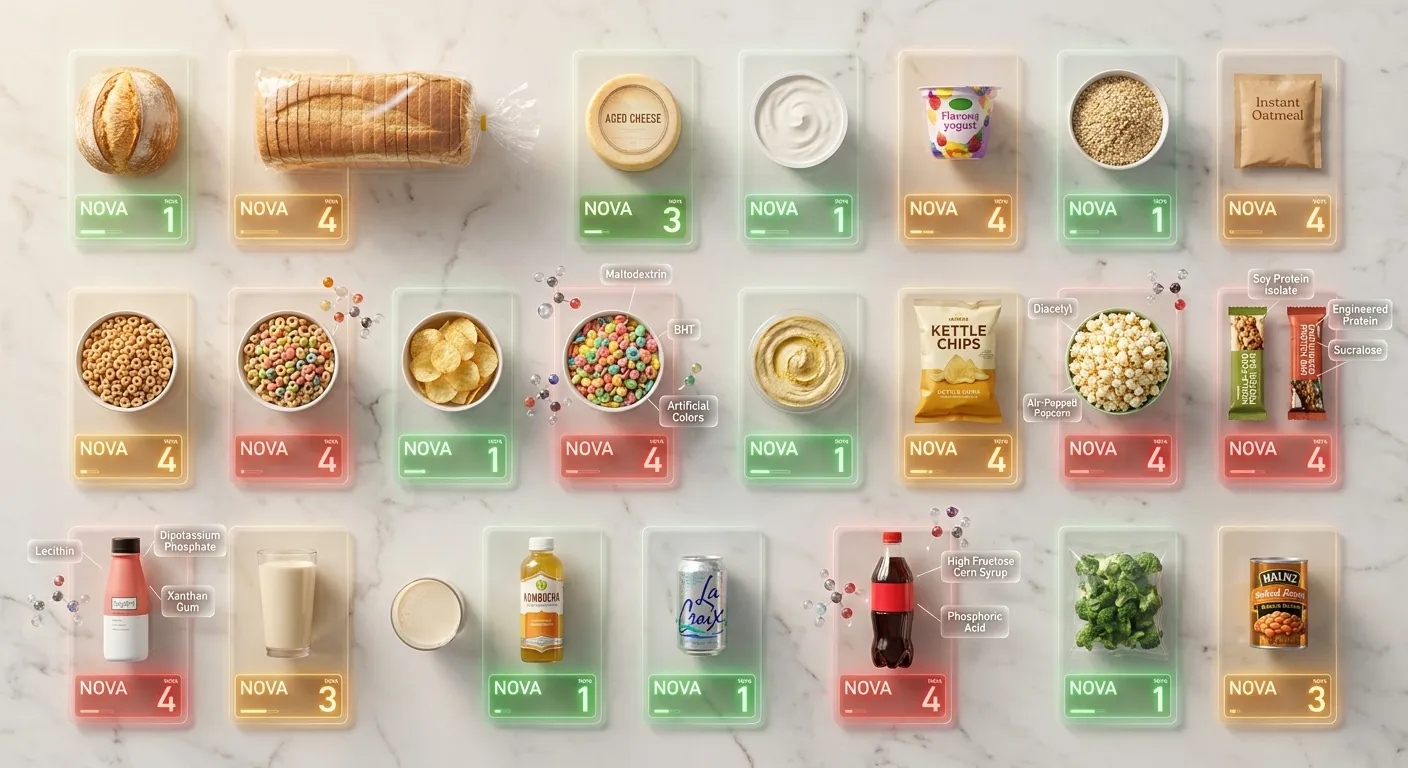
Is It Ultra-Processed? 30 Foods Decoded
A food-by-food NOVA verdict for 30 things in your cart: sourdough vs. supermarket loaf, RXBAR vs. Quest, oat milk vs. barista oat. With the why.
Allulose vs Monk Fruit vs Stevia vs Erythritol
We rank allulose, monk fruit, stevia, and erythritol on taste, baking, gut tolerance, and the 2026 cardiovascular evidence. The label often lies.

Are Seed Oils Bad? 2026 Science Resolved
Are seed oils really toxic? A 2026 verdict on canola, sunflower, and soybean oil, what the latest evidence shows, and where the real metabolic damage starts.
